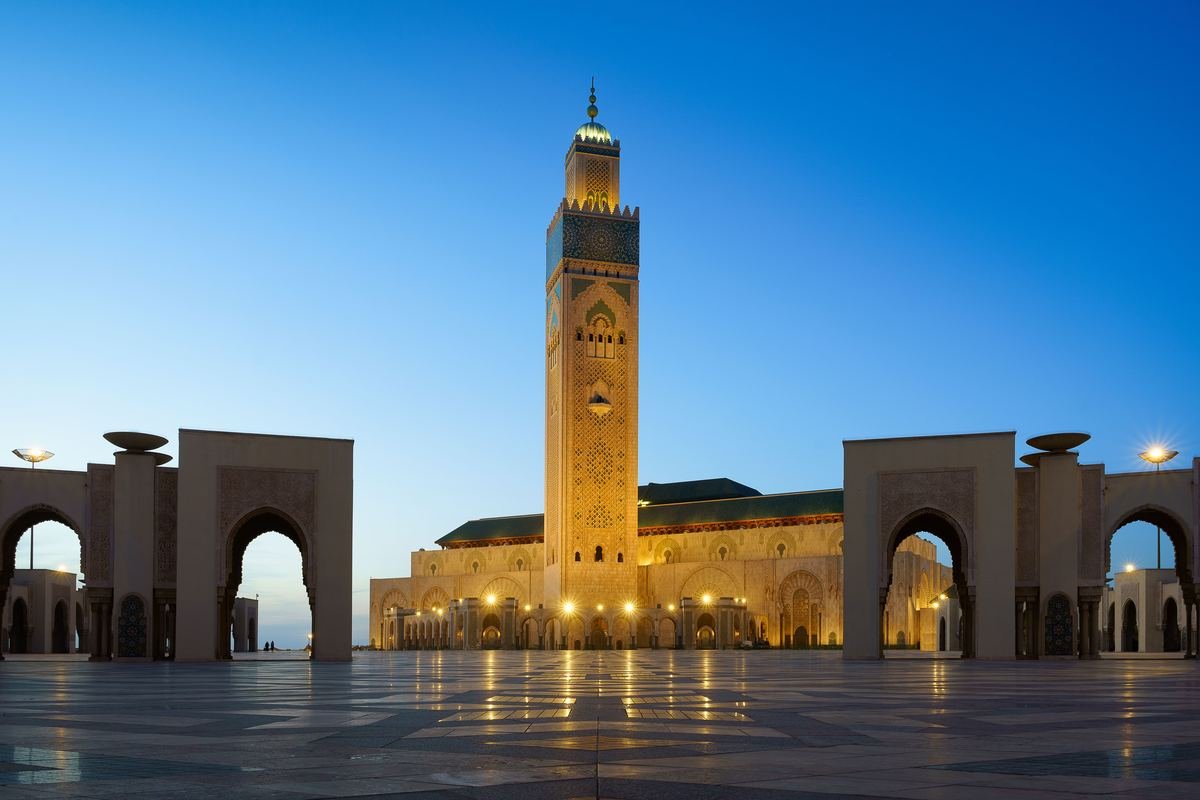
Is Casablanca worth visiting?
Many travellers land in Casablanca and leave immediately for Marrakech or Fez. That is reasonable if your time is short. But one well-planned day — or a night at the beginning or end of your trip — lets you see things you will not find elsewhere in Morocco: the scale of the Hassan II Mosque, a downtown full of Art Deco and Neo-Moorish buildings from the 1910s–1950s, and a lively, contemporary city where most Moroccans actually live and work.
| Airport | Mohammed V International (CMN), about 30 km (19 mi) south of the centre |
| Main train stations | Casa-Voyageurs (long-distance) and Casa-Port (city centre) |
| Population | Around 3.5 million in the city proper; the largest urban area in the Maghreb |
| Ideal stay | 1 full day, or one night on arrival or departure |
| Best for | Modern architecture, the Hassan II Mosque, seafood, urban culture |
The Hassan II Mosque
Completed in 1993 and built partly over the Atlantic Ocean, the mosque has a minaret of about 210 metres, one of the tallest in the world, and a prayer hall that holds around 25,000 worshippers, with room for many more on the esplanade. Thousands of Moroccan craftsmen worked on its marble, carved cedar, stucco and zellige.
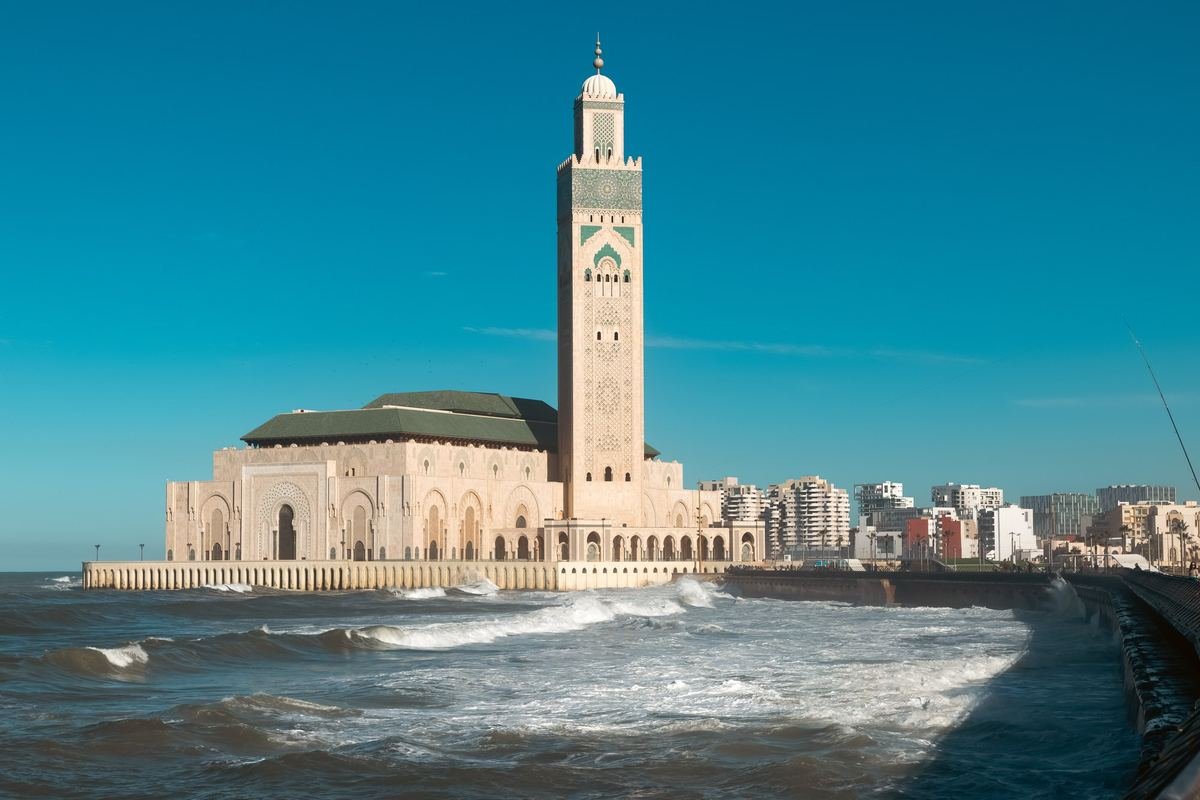
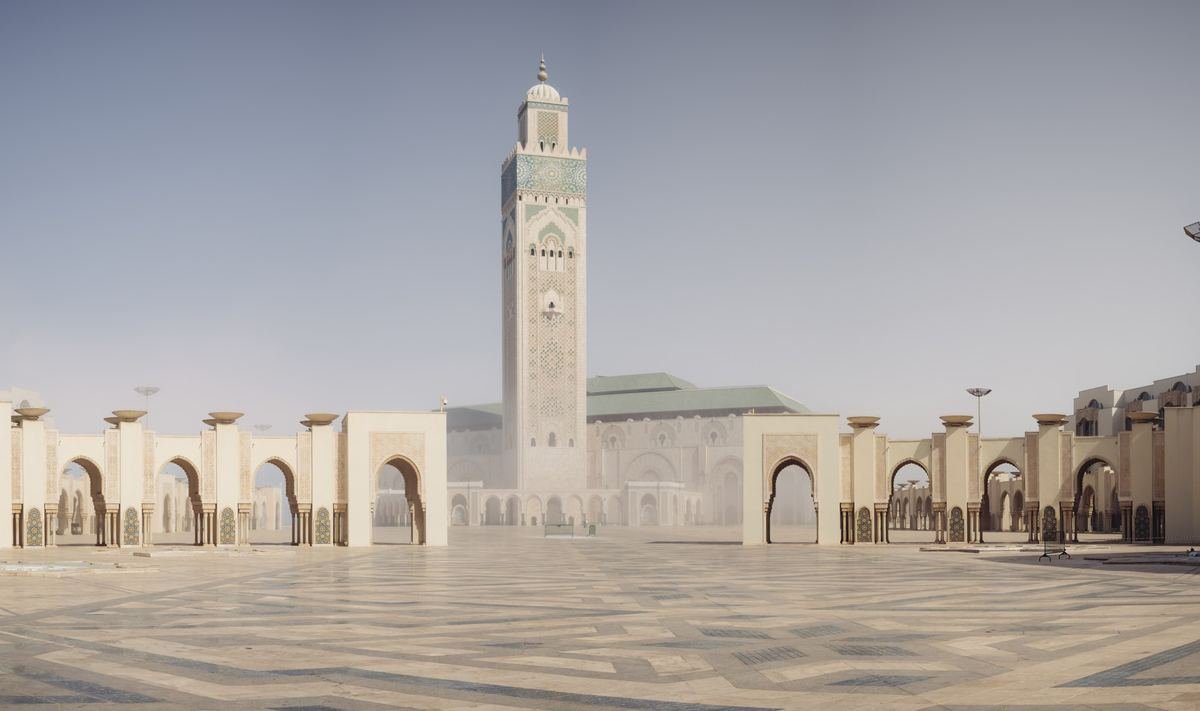
It is one of the few mosques in Morocco open to non-Muslim visitors, through guided tours that run several times a day except during prayer times; Friday schedules are reduced. Tickets are sold at the visitor entrance. Dress respectfully: shoulders and knees covered, and you will remove your shoes inside (bring a bag for them). Check current tour times on arrival, as they change around religious holidays and Ramadan.
Downtown Art Deco
Casablanca grew from a small port to a major city under the French Protectorate (1912–1956), and architects used it as a laboratory. Walk along Boulevard Mohammed V, around Place Mohammed V (the administrative square with the courthouse, post office and Bank Al-Maghrib) and through the streets around the Marché Central to see facades combining Art Deco geometry with Moroccan motifs. Look up: the details are on the upper floors and balconies.
Notable buildings include the Sacré-Cœur Cathedral (1930), a white reinforced-concrete church no longer used for worship and now a cultural venue, and the Marché Central, a covered market where you can buy fish and have it cooked at the small restaurants around the edge.
The local association Casamémoire works to protect this heritage and has, in past years, organised architecture walks and heritage days; check their current programme.
The Habous quarter
Built in the 1930s as a "new medina", the Quartier Habous reinterprets traditional Moroccan architecture with arcades, small squares and tidy lanes. It is a calm, pleasant place to shop for books, olives, pastries and crafts at fair prices, and it is home to the famous pâtisserie traditions of Casablanca. Nearby is the Mahkama du Pacha, a 1940s court building with extraordinary carved interiors (access can be limited).
The old medina and the Corniche
Casablanca's old medina, near the port, is small and less monumental than those of Fez or Marrakech, but its walls and the Sqala bastion, now a restaurant in a garden, are worth a stroll.
The Corniche in the Ain Diab district runs west along the ocean from the Hassan II Mosque, with beach clubs, cafés and restaurants. It is where Casablancans go for a sunset walk at weekends. Swimming is possible at some beaches in summer, but the Atlantic currents can be strong.
The Museum of Moroccan Judaism
In the Oasis district, this small museum — often described as the only museum dedicated to Judaism in the Arab world — documents the long history of Moroccan Jewish communities through objects, clothing and photographs.
Getting around
- Tram: Casablanca's tramway network connects the centre, Casa-Voyageurs station, Ain Diab and many neighbourhoods. Tickets are sold at station machines.
- Petits taxis (red): meters are required; ask the driver to switch it on.
- From the airport: direct trains run from the airport station to Casa-Voyageurs and Casa-Port (around 35–45 minutes), usually hourly. Grand taxis wait outside the terminal with a fixed fare to the centre.
- Onward travel: Al Boraq high-speed trains run north from Casa-Voyageurs to Rabat and Tangier; regular trains go to Marrakech (about 2.5–3 hours) and Fez (about 3.5–4 hours).
Where to stay
- City centre / Maarif: convenient for transport, restaurants and walking to Art Deco streets.
- Ain Diab / Corniche: ocean views, near the Hassan II Mosque and beach clubs; you will need taxis or the tram.
- Near the airport: only for a very early flight.
Food
Casablanca has the most diverse food scene in the country. Seafood is the highlight — at the Marché Central, the port and along the Corniche. You will also find excellent Moroccan home-style restaurants, modern Moroccan cuisine and a wide range of international food.
When to go
The Atlantic keeps Casablanca mild year-round: rarely above 30 °C / 86 °F in summer and rarely below 8 °C / 46 °F in winter. Winter brings most of the rain; summer mornings are often grey with sea mist that burns off by midday.
One-day plan
Morning tour of the Hassan II Mosque, walk along the coast to the old medina and the Sqala for lunch, afternoon in downtown for the Art Deco buildings and the Marché Central, then a taxi to the Habous quarter for pastries before sunset on the Corniche.
Continue to Rabat, just one hour away by train, or see the transport guide.
Frequently asked questions
Can non-Muslims visit the Hassan II Mosque?
Yes, on guided tours that run several times a day outside prayer times, with reduced schedules on Fridays. Dress respectfully and be ready to remove your shoes.
How do you get from Casablanca airport to the city?
Direct trains run from the airport station to Casa-Voyageurs and Casa-Port in about 35–45 minutes. Grand taxis wait outside the terminal with fixed fares.
Is one day enough for Casablanca?
One full day is enough for the Hassan II Mosque, the Art Deco downtown, the Habous quarter and the Corniche.
This guide was last reviewed in October 2026. Entry rules, opening hours, transport timetables and prices change; check official sources shortly before you travel. Spotted something out of date? Tell us.