Where Merzouga is — and how far
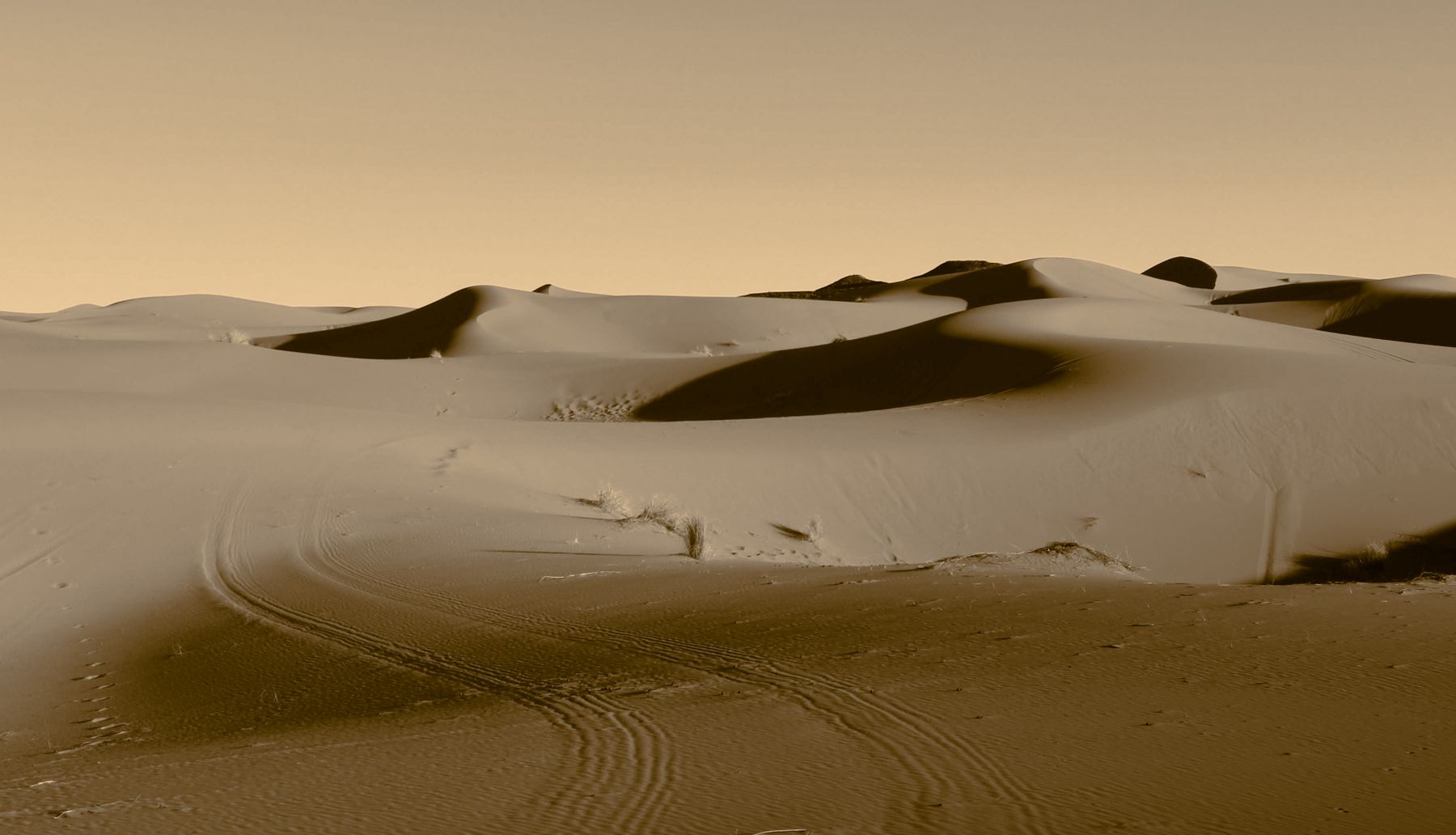
Merzouga is a small village in the Tafilalet region, close to the Algerian border, at the western edge of Erg Chebbi, a sea of sand dunes roughly 22 km long and up to about 150 metres high. It is far from the main cities, and the distance shapes every decision:
| From | Distance | Driving time (approx.) |
|---|---|---|
| Marrakech | about 560 km | 9–10 hours via the Tizi n'Tichka pass |
| Fez | about 470 km | 7–8 hours via Ifrane and the Ziz valley |
| Ouarzazate | about 360 km | 6 hours |
| Errachidia (nearest airport with regular flights) | about 130 km | 2 hours |
There is no realistic one-day or overnight return trip from Marrakech. The standard option is a three-day, two-night circuit (Marrakech → Dades or Todra → Merzouga → back via Ouarzazate) or a one-way route Marrakech → Merzouga → Fez, which avoids doubling back.
Getting there
- Organised tour from Marrakech or Fez: the simplest choice. Shared group tours are inexpensive but long and fast-paced; private tours with a driver let you set the pace and stop where you like.
- Self-drive: roads are paved and in good condition all the way to Merzouga. Driving through the High Atlas and the valleys is one of the great road trips of Morocco; just avoid driving after dark.
- Bus: Supratours and CTM run overnight buses from Marrakech and Fez to Merzouga or Rissani. Your camp then picks you up in the village.
- Flight: Errachidia (ERH) has domestic flights, mostly via Casablanca. Arrange a transfer with your camp.
Choosing a desert camp
Camps are set among or behind the dunes and range widely in comfort.
| Type | What to expect |
|---|---|
| Standard camp | Shared tents or simple private tents, shared bathrooms, mattresses and blankets, dinner around a fire |
| Comfort camp | Private tents with real beds, often with a private toilet and shower |
| Luxury camp | Large tents with en-suite bathrooms, hot showers, better food, sometimes solar heating |
Questions to ask before booking:
- How do you reach the camp — camel, 4x4, or both? (Camels take about 1–1.5 hours each way.)
- Is the bathroom private or shared? Is there hot water?
- Where can I leave my main luggage? (Usually at a hotel in Merzouga — take only a small bag on the camel.)
- Is the camp in the dunes or on their flat edge? Camps deeper in the dunes are quieter and darker at night.
The camel trek
Most visitors ride to camp in the late afternoon and watch the sunset from the top of a dune, then return at sunrise. A few tips:
- Riding a camel is more comfortable leaning slightly back when the animal stands up and kneels down.
- Long trousers prevent chafing.
- If you prefer not to ride, you can walk alongside or reach camp by 4x4.
- Ask how the camels are treated and rested; well-run operators do not overload them.
What to do beyond the dunes
- Khamlia: a village whose residents are descendants of people from sub-Saharan Africa. Families perform Gnawa music for visitors; a donation is expected.
- Rissani: the historic market town of the Tafilalet, birthplace of the Alaouite dynasty. Its souk (busiest on Sundays, Tuesdays and Thursdays) sells dates, spices and livestock. Visit the Ksar Abbar and the mausoleum of Moulay Ali Cherif.
- Sandboarding on the higher dunes.
- Fossils: the area is rich in trilobites and ammonites; workshops in Erfoud cut and polish them. Be aware that some "fossils" sold are reconstructed or fake.
- Dayet Srji: a seasonal lake west of the dunes where flamingos sometimes gather after wet winters.
- Stargazing: with no light pollution, the Milky Way is spectacular on moonless nights. Check the moon calendar when choosing dates.
When to go
The best months are October to April. Days are warm and the light is beautiful, but winter nights (December–February) can drop close to 0 °C — camps provide heavy blankets, and you will want a warm layer, hat and socks. May to September is very hot, often well above 40 °C in the afternoon; if you must go in summer, travel early and late in the day and choose a camp with good ventilation. Sandstorms can occur in spring.
What to pack
- A small backpack for the camp night (leave the suitcase in the village).
- Warm layers for the evening and early morning, even in spring and autumn.
- A scarf or cheche to protect your face from sun and sand.
- Sunglasses, sunscreen, lip balm.
- A torch or headlamp.
- A zip bag to protect your phone and camera from sand.
- Cash — there are ATMs in Rissani and Erfoud, but the camps and villages run on cash.
A three-day circuit from Marrakech
Day 1. Marrakech → Tizi n'Tichka pass (2,260 m) → Aït Benhaddou → Ouarzazate → Dades valley. Overnight in the Dades gorges.
Day 2. Dades → Todra gorges → Tinejdad → Merzouga. Camel trek at sunset, night in a desert camp.
Day 3. Sunrise over the dunes, breakfast, then the long drive back to Marrakech (or onward to Fez).
For a less rushed version, add a night in Ouarzazate or Skoura on the way out and a second night in Merzouga. See our desert road trip itinerary for a detailed version.
Responsible desert travel
The dunes are fragile and the villages depend on scarce water. Take your rubbish back with you, keep showers short in camp, avoid quad-biking over vegetated areas, and favour local, family-run camps and guides.
Related: Ouarzazate, Fez and our 7-day Morocco itinerary.
This guide was last reviewed in October 2026. Entry rules, opening hours, transport timetables and prices change; check official sources shortly before you travel. Spotted something out of date? Tell us.