Where Ouarzazate fits in a trip
Ouarzazate sits at about 1,150 metres on a high plateau south of the High Atlas. Its name is often explained as Amazigh for "without noise". It developed as a French military post in the 1920s and later as a centre for the film industry, which gave it the nickname "Ouallywood".
| From Marrakech | About 200 km, 4–4.5 hours via the Tizi n'Tichka pass (2,260 m) |
| To Merzouga | About 360 km, around 6 hours |
| Airport | Ouarzazate (OZZ), with domestic and a few international flights |
| Ideal stay | 1 night (Aït Benhaddou at sunset or sunrise), 2 to add Skoura or the studios |
| Best for | Kasbahs, desert landscapes, film locations, road trips |
Aït Benhaddou
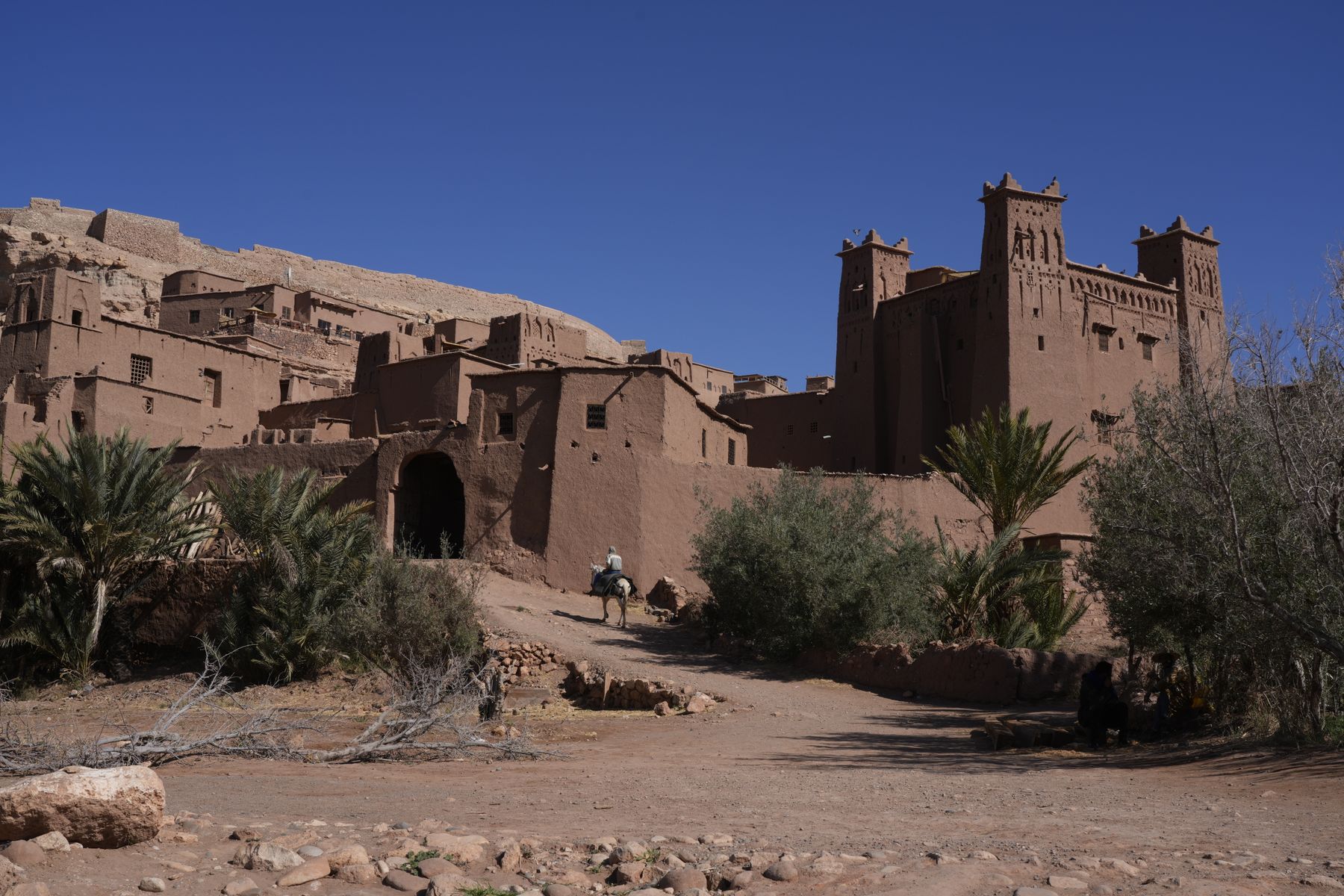
About 30 km north-west of Ouarzazate, Aït Benhaddou is a fortified village (ksar) of earthen houses and kasbahs climbing a hillside above the Ounila river. It was a stop on the caravan route between the Sahara and Marrakech and was inscribed as a UNESCO World Heritage Site in 1987 as an outstanding example of southern Moroccan earthen architecture.
It has appeared in many films and series, including Lawrence of Arabia, Gladiator and Game of Thrones.
How to visit:
- Cross the river on the footbridge from the new village and walk up through the lanes to the granary (agadir) at the top for the panoramic view.
- A few families still live in the old ksar; some houses are open to visitors for a small fee or tip.
- Visit in the late afternoon or early morning. Midday tour buses from Marrakech make it crowded between about 11:00 and 15:00, and the earth walls glow at sunset.
- Stay overnight in one of the guesthouses facing the ksar for the best light.
Ouarzazate town
Taourirt Kasbah. A 19th-century kasbah of the powerful Glaoui family, partly restored and open to visitors. Its courtyards, painted ceilings and the women's quarters give a sense of how the local caïds lived.
Film studios. Atlas Studios and CLA Studios sit on the edge of town. Guided tours take you through sets used in productions such as Gladiator, Kingdom of Heaven and many television series. Interesting for film fans; the sets are partly weathered and some may be closed when productions are shooting.
Museum of Cinema. A small museum across from Taourirt Kasbah displaying props and sets.
Noor Ouarzazate. One of the largest concentrated solar power complexes in the world lies a few kilometres north of the town; it is visible from the road but generally not open to casual visitors.
The valleys around Ouarzazate
Skoura palm grove. About 40 km east, a vast oasis dotted with kasbahs, including the Kasbah Amridil, one of the most photographed in Morocco. Skoura is a peaceful alternative base with charming guesthouses.
Dades valley and gorges. The "Road of a Thousand Kasbahs" leads east through Kalaat M'Gouna (the rose valley, with its rose festival in May) to the Dades gorges, known for the striking switchback road at Tisdrine and its rock formations.
Draa valley. South of Ouarzazate, the road crosses the Anti-Atlas via the Tizi n'Tinifift pass and follows the Draa river through a long chain of palm groves and ksour to Zagora, a gateway to the smaller dunes of Erg Lihoudi and the larger Erg Chigaga (reached by 4x4).
The road over the Tizi n'Tichka
The N9 road from Marrakech crosses the High Atlas at the Tizi n'Tichka pass. The road is fully paved and has been widened, but it is mountainous: allow plenty of time, avoid driving at night, and check conditions in winter, when snow can close the pass for short periods. Worthwhile stops include the village of Telouet, with its crumbling Glaoui kasbah (a detour of about 20 km), and viewpoints over the Ounila valley.
Where to stay
- Aït Benhaddou: guesthouses facing the ksar for sunset and sunrise.
- Ouarzazate: hotels with pools, practical for an overnight on a road trip.
- Skoura: kasbah guesthouses in the palm grove for a slower, quieter stay.
When to go
Autumn, winter and spring are best. Days are sunny and warm; winter nights are cold, often near freezing, so check that accommodation is heated. Summer is hot (often above 38 °C) but dry. Spring brings almond blossom in the valleys and the rose harvest around Kalaat M'Gouna.
Suggested stop on a desert trip
Leave Marrakech early, cross the Tizi n'Tichka, detour to Telouet, arrive at Aït Benhaddou for the late afternoon and stay the night. Next morning, visit Taourirt Kasbah, continue through Skoura and the Dades valley to the gorges, then on to Merzouga the following day.
Related guides: Merzouga and the Erg Chebbi dunes, Atlas Mountains, and the desert road trip itinerary.
This guide was last reviewed in October 2026. Entry rules, opening hours, transport timetables and prices change; check official sources shortly before you travel. Spotted something out of date? Tell us.