Tangier at a glance
From 1923 to 1956, Tangier was an International Zone administered by several foreign powers, a status that attracted diplomats, bankers, spies, writers and artists. Paul Bowles, William Burroughs, Matisse and the Beat Generation all spent time here, and the legend of "Interzone" Tangier still shapes its image. Today it is a major port and industrial hub, with a renovated waterfront and a high-speed train to Rabat and Casablanca.
| Airport | Tangier Ibn Battouta (TNG), about 15 km (9 mi) south-west of the centre |
| Train | Tanger-Ville station; Al Boraq high-speed trains to Kenitra, Rabat and Casablanca |
| Ferries | Tanger-Ville port (Tarifa) and Tanger Med port (Algeciras and other Spanish, French and Italian routes) |
| Ideal stay | 1–2 days |
| Best for | History, literature, views of the Strait, an easy entry from Spain |
The medina and the Kasbah
Grand Socco (Place du 9 Avril 1947). The large square at the entrance to the medina, a busy roundabout with the Mendoubia gardens and the Cinema Rif, a restored Art Deco cinema now home to the Cinémathèque de Tanger.
Petit Socco. The small square in the heart of the medina, once the hub of the International Zone's café society. Have a mint tea at one of the old cafés and watch the world go by.
The Kasbah. At the top of the medina, the walled Kasbah encloses the former sultan's palace, Dar el-Makhzen, now the Kasbah Museum, with archaeological finds and ethnographic collections around Andalusian-style courtyards. Next to it, the Bab el-Bahr terrace offers a view across the Strait to Spain on a clear day.
The American Legation. Morocco was one of the first countries to recognise the United States, and this building, given to the US in 1821, is said to be the first property owned by the US government abroad. Now a museum and cultural centre, it has a fascinating collection of maps, paintings and a room dedicated to Paul Bowles.
St Andrew's Church. An Anglican church built in the 1890s in Moorish style, with the Lord's Prayer inscribed in Arabic and a cemetery where several notable foreign residents are buried.
Viewpoints and cafés
Café Hafa. Opened in 1921 in the Marshan district, this cliffside café with terraced tables overlooking the Strait is a Tangier institution. Order mint tea and bissara soup and stay for the view; it is simple, inexpensive and busy at sunset.
Café de Paris. On Place de France, the classic café of the colonial-era new town, famed for its history as a meeting place of diplomats and writers.
Phoenician tombs. Rock-cut tombs on the Marshan cliffs overlooking the sea, close to Café Hafa.
Cap Spartel and the Caves of Hercules
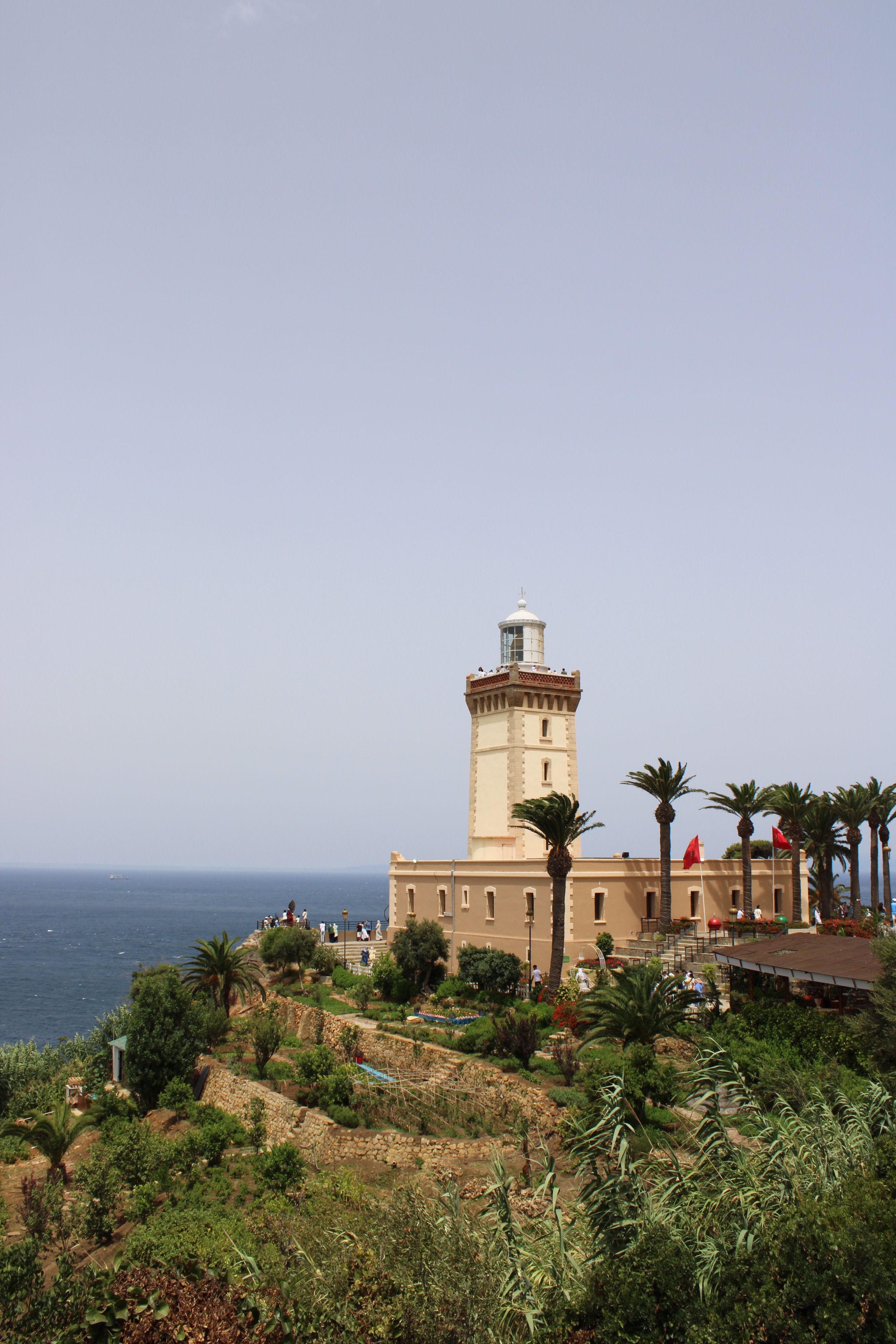
About 14 km (9 mi) west of the centre, Cap Spartel marks the point where the Mediterranean meets the Atlantic; a lighthouse stands on the headland. A few kilometres further south are the Caves of Hercules, a cave complex whose sea-facing opening is often said to resemble the outline of Africa. Combine both with lunch at one of the beach restaurants along the Atlantic coast (Achakar beach). A taxi for the half-day is easy to arrange.
Getting there
- From Spain by ferry: the fast ferry from Tarifa to Tanger-Ville port takes about an hour and arrives right next to the medina — the most convenient option for foot passengers. Ferries from Algeciras usually arrive at Tanger Med, about 45 km (28 mi) east of the city; buses and taxis connect to the centre.
- By high-speed train: Al Boraq links Tangier with Rabat in under 1.5 hours and Casablanca in around 2 hours (times vary by service). Book on the ONCF website or app, especially at weekends.
- By air: direct flights from many European cities.
The high-speed line south from Kenitra to Marrakech is under construction and is planned to open before 2030; until then, travel to Marrakech involves a change in Casablanca or Kenitra.
Getting around
The medina, the Kasbah and the new town around Boulevard Pasteur are walkable, though hilly. Petits taxis (blue with a yellow stripe) are inexpensive; insist on the meter. Use taxis for the Marshan district, Cap Spartel and the train station.
Where to stay
- Kasbah and medina riads: atmospheric, with roof terraces looking over the Strait. Ask about car access and stairs.
- Boulevard Pasteur and the new town: hotels close to cafés, shops and the seafront.
- Marina and Malabata: modern hotels along the bay, with sea views and easy access to the beach promenade.
Food
Tangier's food reflects its position between Morocco and Spain. Look for grilled fish and seafood around the port and the fish market, bissara for breakfast, northern goat cheese, Spanish-influenced tapas-style bars in the new town, and excellent pastry shops on Boulevard Pasteur.
Day trips and onward routes
- Asilah: a whitewashed Atlantic town 45 km (28 mi) south, known for its murals and annual arts festival.
- Tetouan: an Andalusian-style medina, also UNESCO-listed, about an hour east.
- Chefchaouen: about 2.5–3 hours by road; better as an overnight stay.
When to go
Summer (June–September) is warm and breezy and the best time for beaches. Spring and autumn are pleasant. Winter is mild but rainy and windy, and ferry crossings can be cancelled in storms.
Practical tips
- Hustlers at the port and in the medina are less common than they used to be, but unofficial guides still approach arriving ferry passengers. Decline politely.
- Spanish is widely spoken in the north alongside Arabic, Darija and French.
- If you arrive by ferry, change money or withdraw dirhams at the port or in the city; you cannot buy dirhams in most countries before travel.
See also Chefchaouen, our northern Morocco itinerary and the transport guide.
Frequently asked questions
How long is the ferry from Tarifa to Tangier?
The fast ferry takes about an hour and arrives at the Tanger-Ville port next to the medina. Ferries from Algeciras usually arrive at Tanger Med, about 45 km (28 mi) east of the city.
How long is the train from Tangier to Casablanca?
About 2 hours 10 minutes on the Al Boraq high-speed train, which also stops in Kenitra and Rabat.
What is Café Hafa?
A cliffside café in the Marshan district, opened in 1921, with terraced tables overlooking the Strait of Gibraltar. It is a Tangier institution for mint tea at sunset.
This guide was last reviewed in October 2026. Entry rules, opening hours, transport timetables and prices change; check official sources shortly before you travel. Spotted something out of date? Tell us.