Do Nordic citizens need a visa?
No. Citizens of Sweden, Norway, Denmark, Finland and Iceland can visit Morocco without a visa for up to 90 days as tourists. Your passport should be valid for the whole stay — six months' validity is the safe rule — with a blank page for the stamp. A national ID card is not enough: you need a passport. More: visa and entry requirements.
Flights from the Nordic countries
- Direct flights run mainly in the winter season (roughly October to April): SAS and Norwegian have flown to Agadir and Marrakech from Copenhagen and Stockholm, and tour operators such as TUI and Apollo add charter flights from Scandinavian and Finnish airports. Schedules change every season, so check current routes when you plan.
- Flight time is about 5 hours from Copenhagen and 5½–6 hours from Stockholm, Oslo and Helsinki.
- All year, connect through Amsterdam, Paris, Brussels, Frankfurt, Madrid or London to Marrakech, Fez, Tangier or Casablanca.
Time difference
Morocco is on GMT+1: the same time as Scandinavia in winter and one hour behind in summer (one hour behind Helsinki in winter, two in summer). During Ramadan (around February–March in 2027) Morocco moves back to GMT, one hour behind Copenhagen.
Money: kronor, euros and dirhams
Approximate rates in October 2026 (check a live converter before you travel):
| Currency | 1 unit ≈ | 100 MAD ≈ |
|---|---|---|
| Swedish krona (SEK) | 0.99 MAD | 101 SEK |
| Norwegian krone (NOK) | 1.05 MAD | 95 NOK |
| Danish krone (DKK) | 1.48 MAD | 68 DKK |
| Euro (EUR, Finland) | 11.0 MAD | €9.10 |
- You cannot buy dirhams before you leave. Use ATMs on arrival; Scandinavian kronor are rarely exchanged, so bring euros if you want cash to change.
- Cash matters much more than at home: medinas, taxis, markets and small cafés rarely take cards, and mobile payment apps like Swish, Vipps or MobilePay do not work in Morocco.
- Prices are low by Nordic standards; tipping (about 10% in restaurants) is expected. See money and tipping.
Plugs, phones and insurance
- Plugs: type C/E at 220–230 V. Nordic type C and F (Schuko) plugs fit; only Danish type K earthed plugs need an adapter.
- Roaming: Morocco is outside EU/EEA roaming, so check your operator's prices or buy a local SIM or eSIM (guide).
- Insurance: the European Health Insurance Card is not valid in Morocco. Many home and credit-card insurances include travel cover — check the medical and evacuation limits. See health and insurance.
Winter sun: where it is warm
| Place | January day temperature | Good for |
|---|---|---|
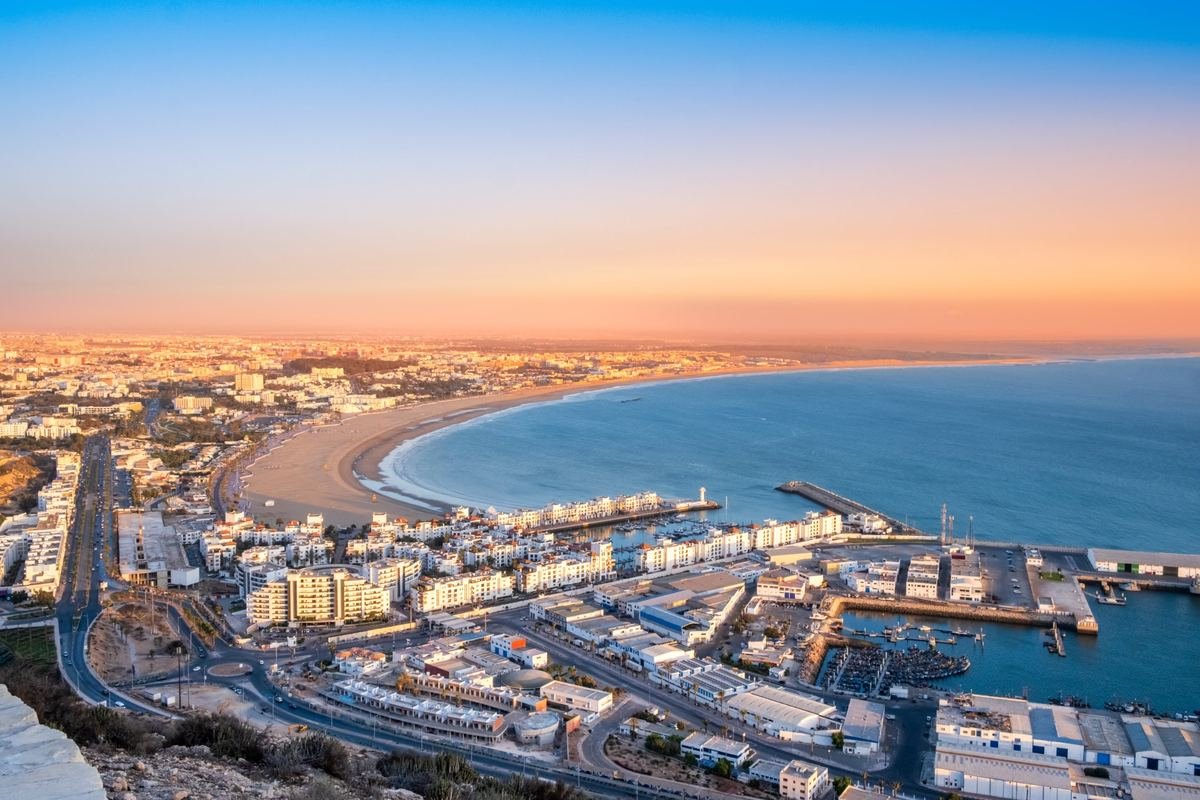
| Agadir and Taghazout | about 20–21 °C / 68–70 °F | Beach, surfing, golf, relaxed hotels |
| Marrakech | about 18–20 °C / 64–68 °F, cold nights | Medina, gardens, day trips to the Atlas |
| Essaouira | about 18 °C / 64 °F, often windy | Ramparts, port, kitesurfing |
| Sahara (Merzouga) | about 18–20 °C / 64–68 °F by day, near 0 °C / 32 °F at night | Desert camps under the stars |
Northern Morocco (Fez, Chefchaouen, Tangier) is cooler and wetter in winter. See weather by month.
Ideas for Nordic travellers
- Surf and yoga in Taghazout, north of Agadir: surf camps for beginners and experienced surfers, best waves from October to April.
- Hiking in the High Atlas from Imlil in spring and autumn, or a winter ascent of Toubkal with a guide and the right equipment. See the Atlas Mountains guide.
- A week combining culture and sun: three nights in Marrakech, then Essaouira or Agadir — see our 7-day itinerary.
- Families: short flights, a small time difference and warm winter weather make Agadir easy with children.
Safety and consular help
Morocco is generally safe; read your government's travel advice (UD in Sweden, Regjeringen/UD in Norway, Udenrigsministeriet in Denmark, UM in Finland) and register your trip where the service exists. Sweden, Norway, Denmark and Finland have diplomatic representation in Rabat or cover Morocco from a neighbouring embassy — check your foreign ministry's website for current contacts. Emergency numbers in Morocco: 19 police, 15 ambulance. See safety and etiquette.
Frequently asked questions
Do Swedes, Norwegians, Danes and Finns need a visa for Morocco?
No. Citizens of Sweden, Norway, Denmark, Finland and Iceland can stay up to 90 days as tourists without a visa. A passport is required; an ID card is not accepted.
Are there direct flights from Scandinavia to Morocco?
Yes, mainly in winter: direct and charter flights link Copenhagen, Stockholm and other Nordic airports with Agadir and Marrakech in about five hours. Year-round, connect through a European hub.
Where is it warm in Morocco in January?
Agadir and Taghazout are the warmest, at about 20–21 °C / 68–70 °F by day. Marrakech reaches 18–20 °C / 64–68 °F with cold nights.
Do I need an adapter for Morocco?
No. Morocco uses the same type C/E sockets and 220–230 V voltage as the Nordic countries.
This guide was last reviewed in October 2026. Entry rules, opening hours, transport timetables and prices change; check official sources shortly before you travel. Spotted something out of date? Tell us.