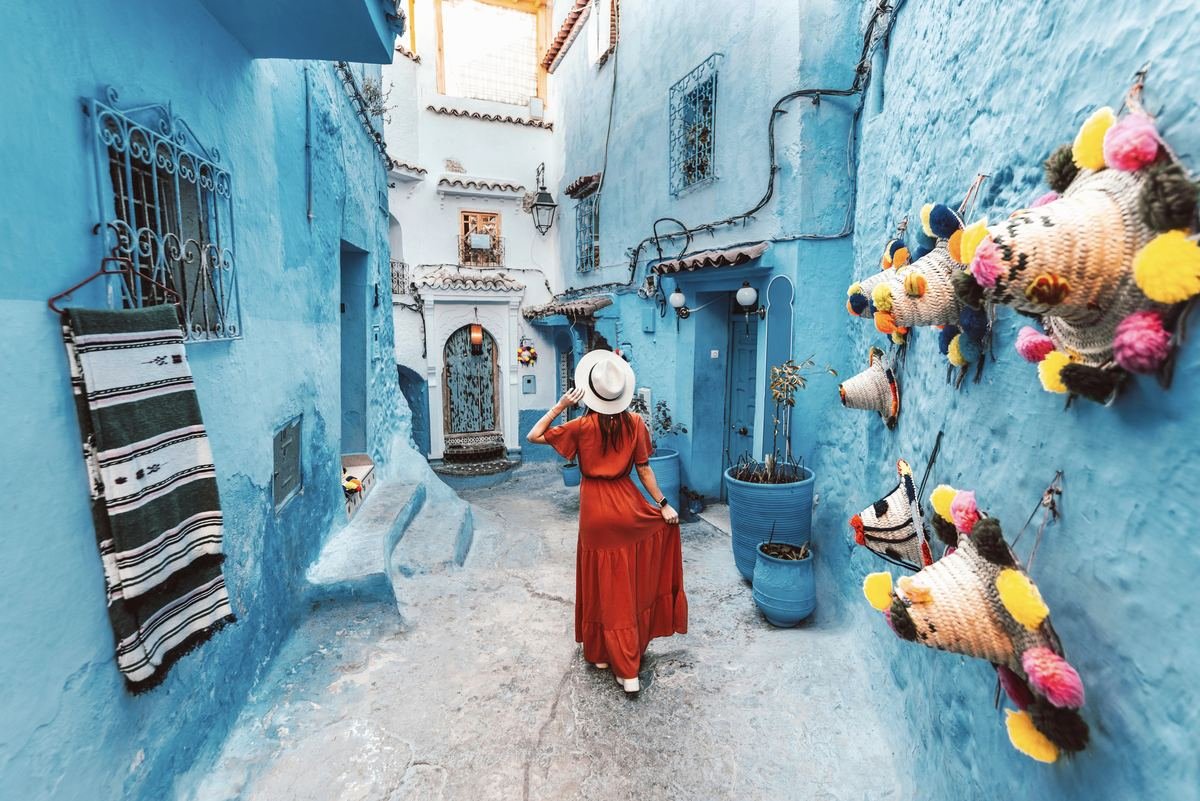
Why Chefchaouen is so photogenic
The medina sits on a slope below the Rif Mountains, so lanes twist, climb and open onto views at every turn. The walls are washed in blues of many shades, often refreshed before spring, and doorways are framed with pots, steps and painted ironwork. The result is a compact town where a short walk produces a great variety of images.
The same qualities make it crowded. Day trips from Fez, Tangier and Tetouan arrive from late morning, and the most famous corners can have queues. Timing is everything. Our Chefchaouen guide covers the town more widely.
The best spots
Plaza Outa el Hammam is the main square, with the red-walled kasbah and the octagonal minaret of the Grand Mosque. It is best photographed in the early evening when café terraces fill and the light softens. A rooftop café gives a higher angle over the square.
The blue lanes of the upper medina (the Souika and Onsar quarters and the area around Bab el Ain) contain the much-shared stairways decorated with plant pots. Some residents decorate their steps deliberately and ask for a small tip, often around 5–20 MAD, to photograph them. That is a fair exchange; pay it or move on.
Ras el Maa, at the north-eastern edge of the medina, is the spring where the stream emerges, with small waterfalls and a communal washing area. It is lovely in morning shade. Women still wash clothes and rugs here: do not photograph them without clear permission.
The Spanish Mosque viewpoint, a disused mosque built during the Spanish period on the hill to the east, is the classic sunset spot. The walk from Ras el Maa takes about 20–30 minutes uphill on a dirt path. From there the whole blue town turns warm in the late light, with the mountains behind. Arrive early to find a place, and bring a torch for the walk down.
When the light is best
- Early morning (sunrise to about 9.30 am): empty lanes, soft even light and the best chance of photographs without crowds. This is the single most useful tip for Chefchaouen.
- Midday: harsh sun bleaches the blues. Work in shaded lanes, where the walls glow a deeper blue.
- Late afternoon: warm side-light in open squares; queues at popular stairways.
- Sunset: head to the Spanish Mosque or a rooftop.
- Blue hour: about 20–30 minutes after sunset, the town lights up against a deep sky; a small tripod helps.
- Overcast days are excellent for the medina, giving rich, even colours without contrast.
Spring (April–June) and autumn (September–October) are the most comfortable seasons. Winter can be cold and wet, which empties the streets but softens colours beautifully.
Photographing residents respectfully
Chefchaouen is a living town of around 40,000 people, not an open-air studio. Behaviour by visitors has led some residents to put up handwritten "No photos" signs on their lanes and doors. Respect them.
- Always ask before photographing a person, and accept a no. A gesture towards your camera and a smile is understood; "Mumkin?" (May I?) helps.
- Do not pose on the doorsteps of private homes or lean against doors; many of the prettiest doors are people's front doors.
- Do not block narrow lanes for long sequences; step aside for residents carrying shopping or children going to school.
- Avoid photographing children without a parent's permission.
- Be discreet near mosques and during prayer times, especially around Friday midday prayers.
- If someone asks you to delete a photo, do so.
Our safety guide also covers wider etiquette in Morocco.
Flying dress photoshoots: how they work
The "flying dress" shoot is a trend imported from places such as Santorini: a photographer provides a long, lightweight dress with a very long train, and an assistant throws the fabric so it billows in the air while you pose on a stairway or rooftop.
A typical shoot:
- Meeting point in the medina or at the photographer's studio, where you choose a dress (some offer several colours and sizes).
- Styling with a quick fitting; you keep your own shoes, often flat sandals.
- Shooting at 3–6 locations, usually stairways, a rooftop and a quieter lane, over about 1–2 hours.
- Delivery of edited images digitally, usually within a few days; some include a short video.
Prices and booking
Prices checked in October 2026 vary widely. Basic group-style shoots listed on booking platforms start from around 200–300 MAD per person for about an hour. A private session with a professional photographer, several dresses and 20–60 edited images typically costs approximately 800–2,000 MAD. Couples and family packages cost more.
| Option | Typical duration | Approx. price (Oct 2026) | Usually includes |
|---|---|---|---|
| Basic flying dress shoot | About 1 hour | 200–500 MAD | 1 dress, a few locations, limited edited photos |
| Private professional shoot | 1.5–2 hours | 800–2,000 MAD | Several dresses, 20–60 edited images |
| Couple or family shoot | 1.5–2 hours | 1,000–2,500 MAD | Group poses, edited images |
| Photo walk with local guide | 2–3 hours | 300–700 MAD | Route, timing advice, no dress |
When booking, ask for the number of edited images, the delivery time and format, whether the price is per person or per group, and the cancellation policy. Recent reviews on some platforms mention short-notice cancellations, so confirm the day before. Pay a deposit only through a booking platform or in person.
Drones are not allowed
Do not bring a drone. Morocco's civil aviation rules prohibit recreational drone use without authorisation, and drones are routinely confiscated at customs on arrival. There is no simple permit process for tourists, so plan for ground and rooftop photography only.
Practical details
- Duration: allow at least one full morning and one sunset; a flying dress shoot takes 1–2 hours.
- Best time: sunrise to 9.30 am for lanes; sunset at the Spanish Mosque; April–June and September–October.
- Price range (checked October 2026): flying dress shoots approx. 200–2,000 MAD; step tips 5–20 MAD.
- Booking: book private shoots a few days ahead in spring and autumn; confirm by message the day before.
- What to bring: a wide-angle lens or phone, small tripod, comfortable shoes for steep lanes, a torch, cash in small notes. See our packing list.
Frequently asked questions
What is the best time to photograph Chefchaouen?
Early morning, before about 9.30 am, gives empty streets and soft light. For views over the town, go to the Spanish Mosque at sunset.
How much is a flying dress photoshoot in Chefchaouen?
Prices checked in October 2026 range from around 200–300 MAD per person for a basic shoot to approximately 800–2,000 MAD for a private professional session.
Can I fly a drone in Chefchaouen?
No. Recreational drones are prohibited in Morocco without authorisation and are usually confiscated at customs.
Is it rude to take photos in Chefchaouen?
Photographing the streets is normal, but always ask before photographing people, respect "No photos" signs and avoid posing on private doorsteps.
How long does it take to walk to the Spanish Mosque?
About 20–30 minutes uphill from Ras el Maa on a dirt path. Bring a torch for the walk down after sunset.
This guide was last reviewed in October 2026. Entry rules, opening hours, transport timetables and prices change; check official sources shortly before you travel. Spotted something out of date? Tell us.