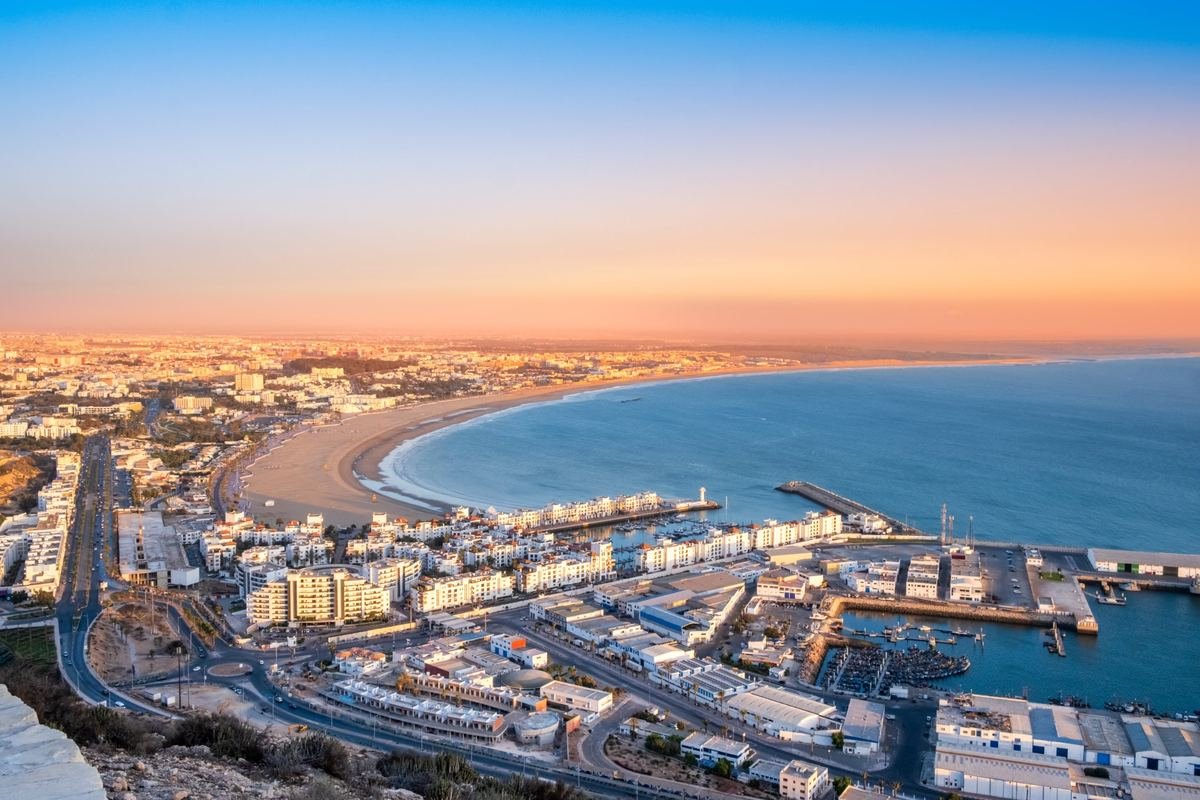
Agadir in brief
Agadir looks new because it is. On 29 February 1960 an earthquake destroyed most of the old town and killed an estimated 12,000 to 15,000 people. The city was rebuilt a little further south, with wide avenues, low modernist buildings and a long seafront promenade. What it lacks in old medinas it makes up for in space, sunshine and an easy pace.
| From Marrakech | About 250 km (155 mi), roughly 3 hours on the A7 motorway |
| Airport | Agadir–Al Massira (AGA), about 25 km (15 mi) south-east of the centre |
| Railway | None yet: arrive by air, bus (CTM, Supratours) or car |
| Ideal stay | 3–5 nights, more if you surf |
| Climate | Mild all year, many sunny days, cool mornings in winter |
| Best for | Beach time, surfing, winter sun, day trips to the Anti-Atlas |
What to see in Agadir
The beach and the promenade. The bay curves for several kilometres from the port to the south of the city. The sand is wide and clean, and the bay is more sheltered than most of the Atlantic coast, which makes it one of the easier places in Morocco for a swim. The promenade (the corniche) is lively in the evening, especially at weekends.
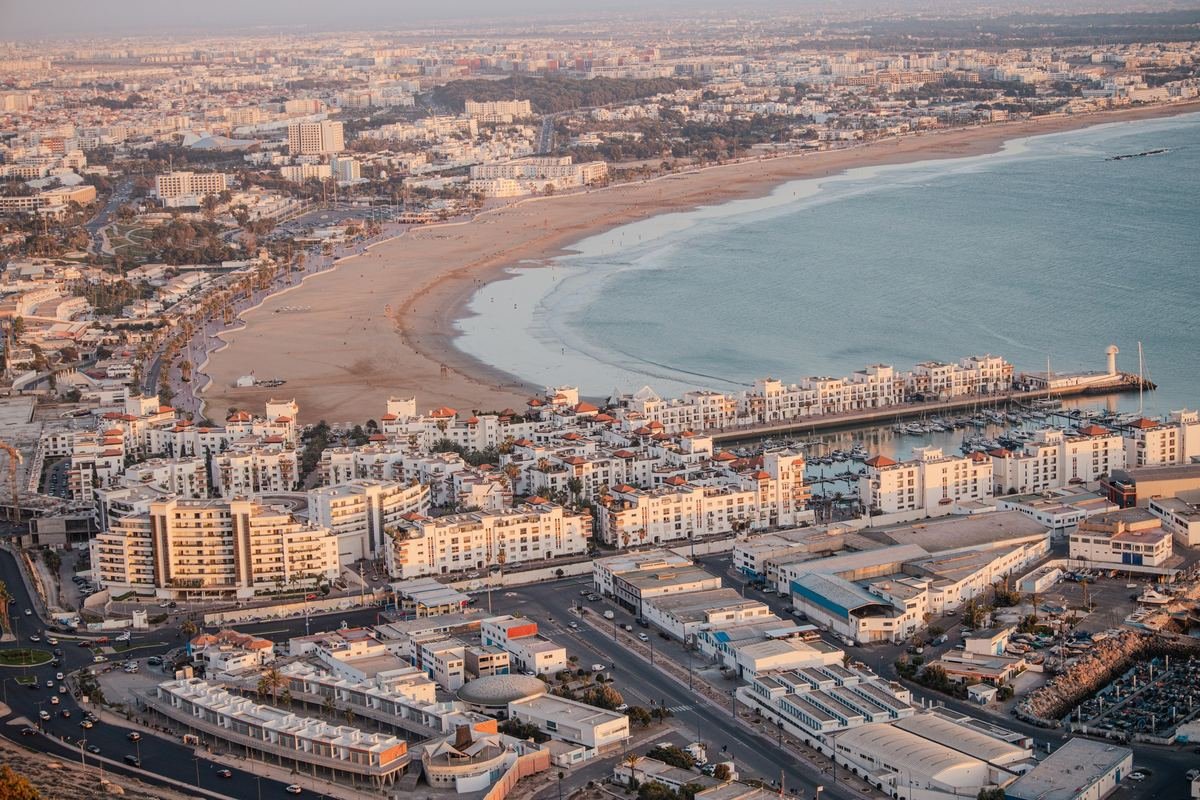
Agadir Oufella. The ruins of the 16th-century kasbah stand on the hill above the port, the only part of old Agadir that remains. The walls survived the earthquake; the town inside did not. The view over the bay is the reason to come, ideally at sunset. On the hillside below, the Arabic words for "God, Country, King" are laid out in large letters that are lit at night.
The cable car. Since 2022 a cable car has linked the lower town to the kasbah, replacing the steep road or taxi ride. Check the operating hours locally, as they change with the season.
Souk El Had. One of the largest markets in Morocco, enclosed by walls with several gates. Fruit, vegetables, spices, olives and household goods sit next to crafts and souvenirs. It is far less pushy than the souks of Marrakech, and a good place to see where people from Agadir actually shop.
The port. A working fishing harbour north of the beach. The simple fish restaurants near the entrance grill the day's catch; ask the price before ordering.
Medina Polizzi. A reconstructed "medina" built from the 1990s by the Italian architect Coco Polizzi, using traditional techniques and craftsmen. It is a modern creation rather than a historic site, but the workshops and architecture are worth an hour.
Surf: Taghazout and the north coast
The coast north of Agadir is one of the best-known surf areas in North Africa. Taghazout, about 20 km (12 mi) north, is a former fishing village that now lives largely from surf camps, with breaks for beginners on the beaches and famous right-hand point breaks for experienced surfers. Tamraght and Aourir, between Agadir and Taghazout, are quieter bases with surf schools and guesthouses.

The most consistent swell runs from autumn to spring, roughly October to April. Beginners can learn all year on the sheltered beaches. Lessons usually include the board, wetsuit and transport to the right spot for the day's conditions; our surfing guide explains how to choose a school.
Day trips from Agadir
- Paradise Valley. A palm-lined gorge with rock pools in the hills north-east of Agadir, about an hour's drive. Go early and avoid weekends in summer, when it gets crowded.
- Souss-Massa National Park. Dunes, estuaries and wetlands south of the city, best known for its colony of the rare northern bald ibis. A guide makes it easier to see the birds.
- Taroudant. A walled market town about 85 km (53 mi) east, often called a smaller, calmer Marrakech, with ramparts you can walk around in an hour.
- Tafraout and the Anti-Atlas. Pink granite valleys, almond trees and painted rocks, about three hours away. It deserves a night rather than a rushed day trip: see our Tafraout guide.
- Essaouira. About three hours north along the coast road; better as a separate stay than a day trip. See the Essaouira guide.
Workshops and activities
Agadir is a good place to try a craft. Zellige (cut-tile mosaic) and pottery workshops let you make a small piece to take home, usually in two to three hours; our mosaic workshop guide explains what to expect. Horse and camel rides on the beach, quad excursions into the dunes south of the city and boat trips from the marina are widely offered. Choose operators who provide helmets and safety equipment, and agree the price and duration before you start.
Where to stay
The seafront hotel strip suits families and anyone who wants to walk to the beach. Large all-inclusive resorts sit at the southern end of the bay.
The marina and Founty are newer, with apartments and restaurants close to the sand.
Taghazout and Tamraght are the choice for surfers and for travellers who prefer a village atmosphere to a resort; most accommodation there is in surf houses and small guesthouses.
Getting there and around
The airport has direct flights from many European cities, especially in winter. Taxis to the centre take about 30 minutes; agree the fare or check the official rate board at the exit. CTM and Supratours buses connect Agadir with Marrakech, Essaouira, Tiznit and other cities. In town, the small orange petits taxis are cheap; ask the driver to use the meter. City buses run along the coast to Taghazout.
When to go
Agadir is a year-round destination. Winter (November–March) is the main season for European visitors looking for sun: days are mild and nights cool. Spring and autumn are the most pleasant overall. Summer is busy with Moroccan families; the coast stays cooler than the interior, but sea fog can cover the bay in the morning. The Atlantic is cool all year, coldest in late winter.
Two-day plan
Day 1. Morning at Souk El Had, lunch at the port, afternoon on the beach, then the cable car to Agadir Oufella for sunset and dinner on the promenade.
Day 2. A surf lesson in Taghazout or Tamraght in the morning, lunch by the sea, and Paradise Valley in the afternoon. With a third day, add Taroudant or a zellige workshop.
Continue south-east to Tafraout, north to Essaouira, or plan the coast with our map of Morocco.
Book surf lessons and workshops in Agadir
These activities are run by local operators and booked through our partner Hayya Morocco. Prices, schedules and availability are shown on their site.


Frequently asked questions
Is Agadir worth visiting?
Yes, if you want beach time, surf or winter sun. It is not a city of historic monuments, because the old town was destroyed in the 1960 earthquake, but it is a comfortable base for the coast and the Anti-Atlas.
Can you swim in Agadir?
Yes. The bay is more sheltered than most of Morocco's Atlantic coast. The water is cool all year, and you should still follow the flags and swim where lifeguards are present.
How far is Taghazout from Agadir?
About 20 km (12 mi), or 30 to 40 minutes by taxi or city bus depending on traffic.
How do you get from Marrakech to Agadir?
By car or bus on the A7 motorway, in about three hours. There is no railway to Agadir.
This guide was last reviewed in November 2026. Entry rules, opening hours, transport timetables and prices change; check official sources shortly before you travel. Spotted something out of date? Tell us.