The three main types of class
Classes in Marrakech and Fez fall into three broad formats. None is better in absolute terms; it depends on how much time you have and what you want to learn.
| Format | Where | Duration | Best for |
|---|---|---|---|
| Riad or house class | A guesthouse kitchen or rooftop in the medina | 3–4 hours | Short stays, small groups, relaxed atmosphere |
| Market tour + class | Starts in a souk or neighbourhood market, then a kitchen | 4–5 hours | Understanding ingredients, spices and shopping |
| Countryside or farm class | Villages outside Marrakech, the Ourika valley or near Fez | 5–7 hours with transfers | Clay ovens, gardens, bread baking, rural setting |
Riad classes are the easiest to fit into a city break. A cook (often a dada, the traditional household cook, sometimes a trained chef) works with a group of four to twelve people around shared tables. Market tours add a walk through the produce, spice and butcher stalls, which is valuable if you want to know what you are buying later. Countryside classes often include baking flatbread in a wood-fired oven and harvesting herbs; they cost more because of transport.
What you typically cook
Most classes produce a three-course lunch or dinner that you then eat together. A common structure:
- Cooked salads: zaalouk (smoky aubergine and tomato), taktouka (peppers and tomatoes), carrot salad with cumin and orange blossom.
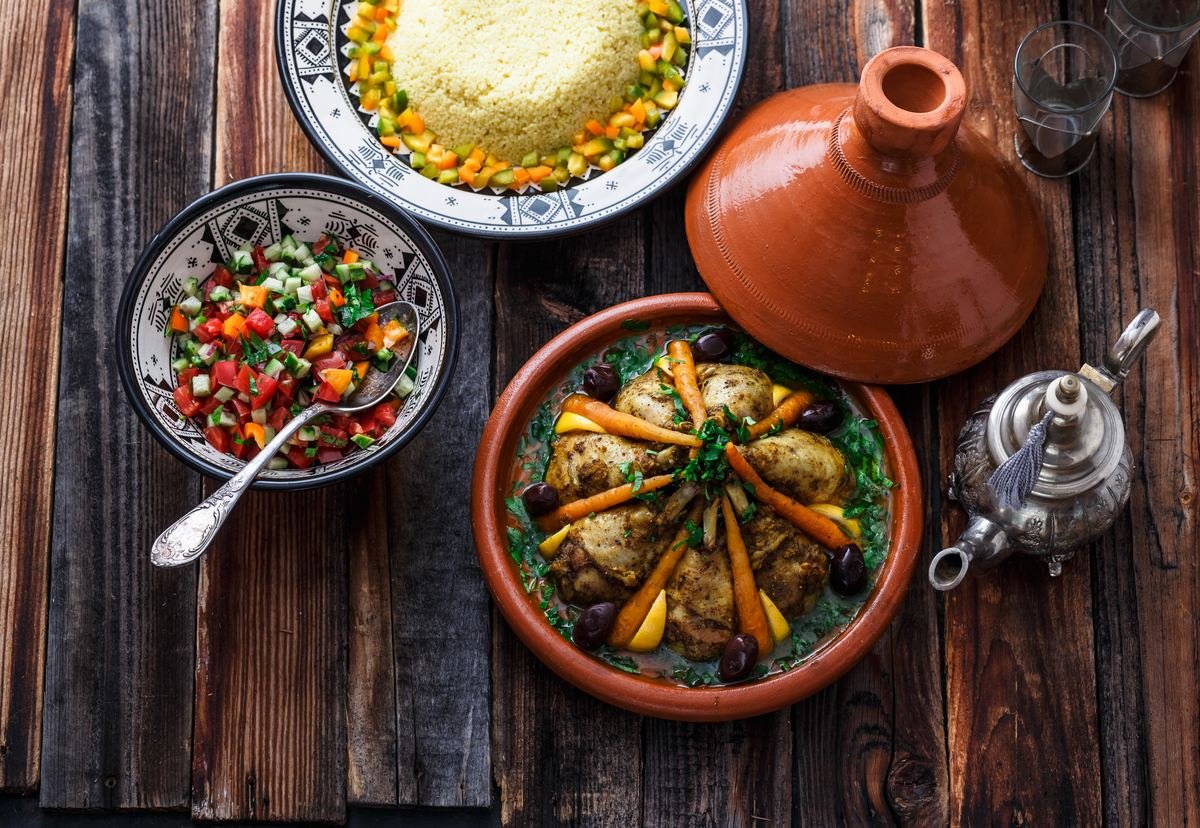
- A main tagine: chicken with preserved lemon and olives, beef or lamb with prunes and almonds, or a vegetable tagine.
- Bread: khobz, the round everyday loaf, sometimes msemen (layered flatbread).
- Dessert: orange slices with cinnamon, or simple pastries.
More elaborate classes add pastilla, the sweet-savoury pie with chicken or pigeon, cinnamon and almonds in thin warqa pastry. Couscous is traditionally a Friday dish, eaten after midday prayers, so some classes only teach it on Fridays or on request. Hand-rolling couscous grains is now rare even in Moroccan homes; you will most likely steam pre-made couscous in a couscoussier.
Dietary needs
Moroccan cooking adapts well to most diets, but tell the organiser when you book, not on arrival, because the shopping is often done that morning.
- Vegetarian: very easy. Vegetable tagines, salads and seven-vegetable couscous are traditional dishes. Ask whether stocks or smen (aged butter) are used.
- Vegan: possible, but butter and honey appear frequently; confirm in advance.
- Gluten-free: tagines and salads are naturally gluten-free, but bread, couscous, pastilla and msemen are wheat-based. A shared kitchen with flour in the air is not suitable for coeliac disease; ask whether a separate area is possible.
- Halal: all meat sold in Moroccan markets is halal, and classes do not use pork. Alcohol is not normally served at riad classes.
Duration and price ranges
Prices below are typical ranges checked in October 2026. They usually include ingredients and the meal; transport is included for countryside classes.
| Class type | Typical price per person |
|---|---|
| Shared riad class, medina | approx. 350–700 MAD (€32–64) |
| Market tour + class, shared | approx. 450–900 MAD (€40–80) |
| Countryside or farm class with transfer | approx. 600–1,200 MAD (€55–110) |
| Private class (per person, 2 people) | approx. 900–2,000 MAD |
Classes run all year, usually from around 09:30 or 10:00 to mid-afternoon, with some evening sessions. In summer, a morning class in a shaded courtyard is more comfortable than a rooftop at 14:00, when temperatures can exceed 38 °C / 100 °F. For broader budgeting advice see money and payments.
How to choose a good class
- Group size: six to ten participants is a good balance; more than fifteen often means you watch rather than cook.
- Hands-on time: ask whether each person or pair prepares their own tagine, or whether one is cooked for the group.
- Who teaches: a cook from the household is often more authentic than a scripted presenter; a translator may be present.
- Written recipes: good classes give you recipes, ideally with weights, to take home.
- Hygiene: look for clean surfaces, hand-washing stations and fridges; your stomach will thank you. Our health guide covers food-related illness.
- No forced shopping: some market tours end at a spice shop where prices are high and pressure is strong. Ask in advance whether a shop visit is included and say if you would rather skip it.
- Women-run cooperatives and social enterprises exist in both cities and in villages; they are a good option if you want your money to support local women's income.
Spices to bring home, and customs
The souks sell excellent spices, but quality varies. Buy from stalls with a high turnover, smell before buying and avoid the tourist pyramids of powder that have sat in the sun.
- Ras el hanout: a house blend of up to twenty or more spices; each seller's version differs.
- Cumin, sweet paprika, ginger, turmeric and cinnamon: the backbone of most tagines.
- Saffron: genuine Moroccan saffron comes from the Taliouine region and is expensive. Very cheap "saffron" is usually safflower or dyed fibres; real threads colour water slowly and smell of honey and hay.
- Preserved lemons and olives: best made at home, as jars can leak in luggage.
Customs: sealed, dried spices for personal use are generally allowed into the UK and EU. The United States requires you to declare food items, and Australia and New Zealand have strict biosecurity rules on seeds, plant material and some spices. Check your own country's current rules before buying large quantities, and keep spices sealed and labelled. Our packing list suggests how to carry them.
A classic chicken tagine with preserved lemon and olives
This is the dish most classes teach first. The method below is a summary for four people, not a precise recipe.
- Marinate: rub a jointed chicken (about 1.2–1.5 kg) with grated onion, crushed garlic, ground ginger, turmeric, black pepper, a pinch of saffron soaked in warm water, chopped coriander and parsley, and olive oil. Leave for at least 30 minutes.
- Build the base: lay a thick bed of sliced onion in the tagine or a heavy pan. Arrange the chicken on top, skin side up, and add a small glass of water.
- Cook slowly: cover and cook on a low flame (use a heat diffuser under a clay tagine) for around 60–75 minutes, adding a little water if the base dries.
- Finish: add the rinsed peel of one or two preserved lemons, cut into strips, and a handful of green or violet olives for the last 15 minutes. Reduce the sauce until it is thick and glossy.
- Serve straight from the pot with khobz to scoop the sauce.
The key lessons are low heat, little liquid and patience: a tagine steams in its own juices rather than boiling.
Practical details
- Duration: 3–4 hours for a riad class; 4–5 hours with a market tour; 5–7 hours for countryside classes.
- Best time: all year; mornings are best in summer.
- Price range: approximately 350–900 MAD per person for shared classes; private classes from about 900 MAD per person (checked October 2026).
- Booking ahead: one to three days ahead for shared classes; earlier for private or Friday couscous classes.
- What to bring: an appetite (skip a big breakfast), notebook or phone for photos, closed shoes, dietary information, and cash for spice purchases.
Fit a class into the Marrakech weekend itinerary or a longer 7-day route, and browse more experiences.
Frequently asked questions
Do I need any cooking experience?
No. Classes are designed for beginners, and the cooks show each step. Experienced cooks can ask about technique, spice ratios and variations.
Can vegetarians join a Moroccan cooking class?
Yes. Vegetable tagines, salads and vegetable couscous are traditional dishes, and most classes adapt easily if you tell them when booking.
Should I take a class in Marrakech or Fez?
Both cities have strong food traditions. Fez is known for refined dishes such as pastilla and has a quieter class scene, while Marrakech offers the widest choice of formats and schedules.
Can I bring a clay tagine home?
Yes, but glazed decorative tagines are often for serving only and may not be safe for cooking. Buy an unglazed or food-safe cooking tagine, wrap it well and carry it in hand luggage if possible.
Is a market tour worth the extra cost?
If you want to understand ingredients and shop confidently later, yes. If you only want to cook and eat, a riad class without the tour is shorter and cheaper.
This guide was last reviewed in October 2026. Entry rules, opening hours, transport timetables and prices change; check official sources shortly before you travel. Spotted something out of date? Tell us.