What is in the glass
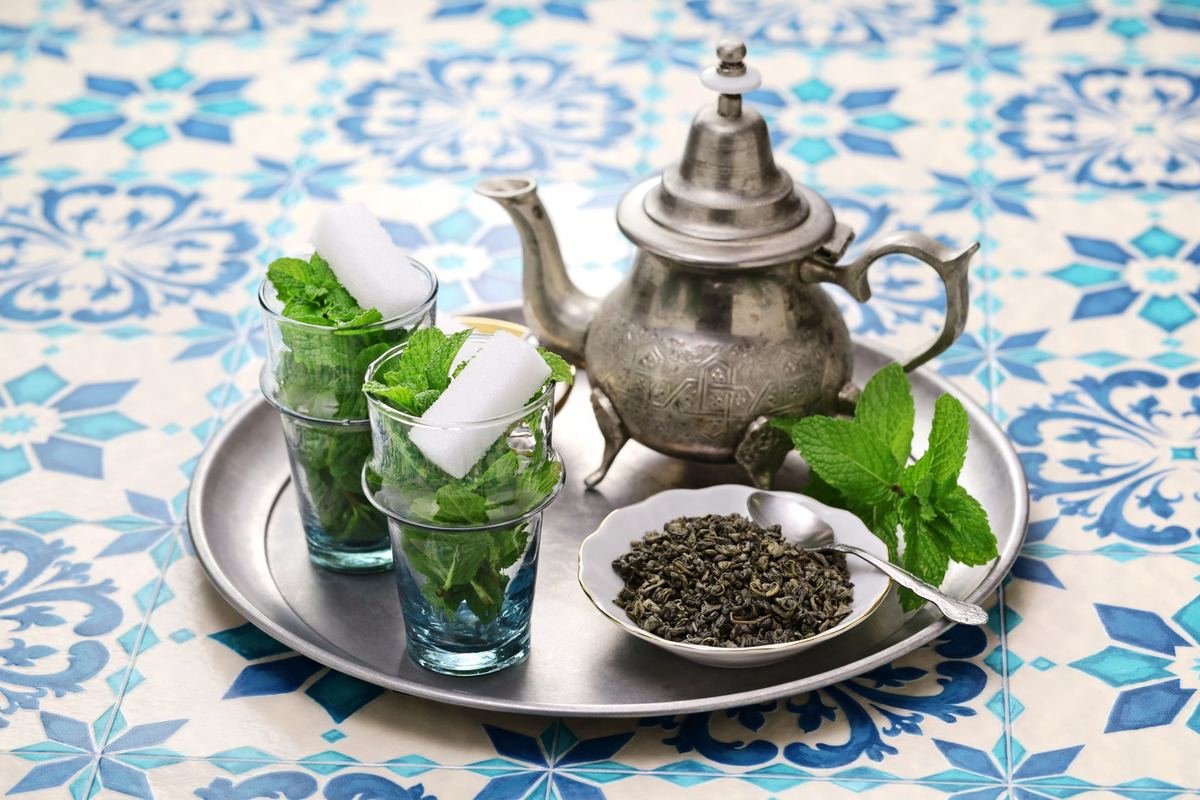
Moroccan mint tea is made from three things: Chinese green tea, fresh spearmint and sugar, steeped in boiling water and poured from a height.
- The tea is almost always gunpowder, Chinese green tea rolled into small pellets, imported in large volumes. Morocco is regularly China's biggest export market for tea, taking more than 70,000 tonnes a year. In shops you will see it in boxes and bulk sacks, graded by pellet size; the finer, shinier pellets are better.
- The mint is spearmint, nana. Bunches are sold for a few dirhams from handcarts and market stalls every morning. It should be bright, fragrant and not wilted. The mint grown around Meknes is particularly prized.
- The sugar traditionally came as a hard cone (qalb or ras sukkar), broken with a small hammer. Many households now use sugar lumps or granulated sugar. Moroccan tea is sweet by default: sometimes very sweet.
Tea reached Morocco through European trade in the 18th and 19th centuries, initially as a luxury of the court and urban elites. Imports grew sharply in the mid-19th century, and by the early 20th century it had spread across the country, from the cities to the Sahara.
How it is made
Methods vary by family, but most follow the same sequence.
- Warm the teapot with boiling water and add about a tablespoon of gunpowder tea.
- Make the "spirit": pour in a small glass of boiling water, swirl, and set this first concentrated infusion aside in a glass.
- Wash the leaves: add more boiling water, swirl briefly and discard it, removing dust and some bitterness.
- Return the spirit, add the mint, packed in firmly, and the sugar, then fill with boiling water and steep for a few minutes.
- Mix by pouring: pour a glass and tip it back into the pot two or three times to blend the sugar, then taste and serve.
The pour from height
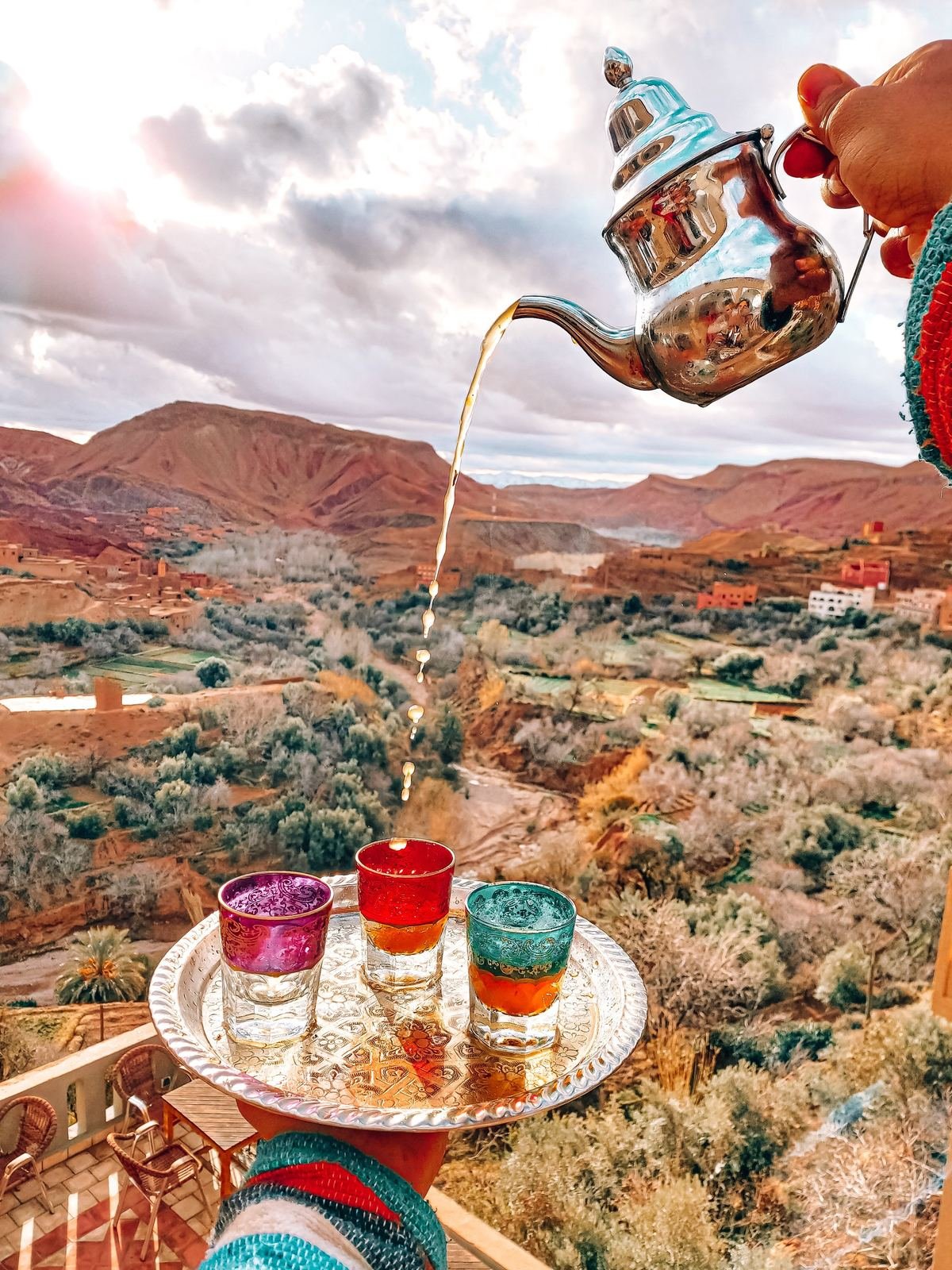
The host lifts the teapot as high as 30–50 cm above the small glass and pours in a long, thin stream. The height cools the tea a little, aerates it and raises a light foam on the surface, which Moroccans call the "turban" or crown. A glass without foam is considered poorly served. Glasses are filled only half to three-quarters full, so you can hold them by the rim without burning your fingers.
Tea as a social institution
Mint tea is the default gesture of hospitality. It is offered in homes, in riads on arrival, at the end of a meal, during negotiations in the souks and at every family occasion. Serving it is an honour, traditionally given to the head of the household or an elder.
The café is the other half of tea culture. In every town you will find terraces with rows of chairs facing the street, where men sit for hours with a glass of tea or a nous-nous (half coffee, half milk), watching the passers-by and the football. Women are welcome in newer cafés and those in tourist areas; in small-town cafés the clientele is still mostly male. Tea is also part of the Ramadan evening, drunk after the ftour meal of harira and dates.
Etiquette: accepting, refusing and being a good guest
Accept at least one glass. Refusing tea outright, especially in someone's home, can seem cold. If you do not want caffeine or sugar, accept a glass and take a few sips.
Refusing politely. When you have had enough, place your hand on your heart and say "safi, shukran" (that's enough, thank you) or "baraka, shukran". Leaving a little in the glass also signals you are done. Our language guide has more phrases.
Let the host pour. Do not refill your own glass or take over the teapot unless invited.
Sugar. In a home the sugar is already in the pot, and asking for none is awkward. In cafés you can ask for "shwiya sukkar" (a little sugar) or "bla sukkar" (without sugar); many cafés will bring the sugar separately if you ask before they make it.
Tea in shops. Carpet and craft dealers often offer tea while you browse. Accepting is courteous and does not oblige you to buy, although it does slow the visit down. See our souk guide for bargaining and safety guide for advice on touts.
Three glasses. In the south and the Sahara, hosts traditionally serve three rounds from the same leaves, each stronger and more bitter than the last. A proverb compares them to life, love and death. It is polite to stay for all three if your host is preparing them; leaving after the first can feel abrupt.
Regional and seasonal variants
| Variant | Where and when | What changes |
|---|---|---|
| Classic atay b'nana | Everywhere, all year | Gunpowder tea, spearmint, sugar |
| Shiba (wormwood) | Winter, especially in the north and the Atlas | Wormwood (Artemisia) added with or instead of mint; bitter and warming |
| Louiza (lemon verbena) | All year, popular in Fez and Meknes homes | Lemony; also drunk alone as an infusion in the evening |
| Herb mixes | Atlas villages, winter | Thyme, sage, pennyroyal (fliyou) or absinthe in the pot |
| Saharan tea | Merzouga, M'Hamid, the deep south | Stronger, boiled longer on embers, served in three rounds, often with little or no mint |
| Orange blossom | Celebrations, some Fez homes | A few drops of orange flower water in the glass |
In winter, market sellers will add a sprig of shiba to your mint bunch if you ask.
What tea costs in 2026
Prices are typical ranges as of autumn 2026 (indicative estimates).
| Where | Typical price |
|---|---|
| Neighbourhood café, glass | approx. 8–15 MAD |
| Neighbourhood café, small pot for one or two | approx. 12–20 MAD |
| Rooftop café overlooking Jemaa el-Fna or a medina square | approx. 20–40 MAD |
| Riad or boutique hotel terrace | approx. 30–60 MAD a pot |
| Bunch of fresh mint at the market | approx. 2–5 MAD |
| Gunpowder tea, 200 g box in a grocery | approx. 15–35 MAD depending on grade |
Riads usually offer tea free on arrival. See money and payments.
Teapots and tea glasses as souvenirs
A teapot (berrad), a tray and a set of glasses (kisan) are among the most practical things to bring home.
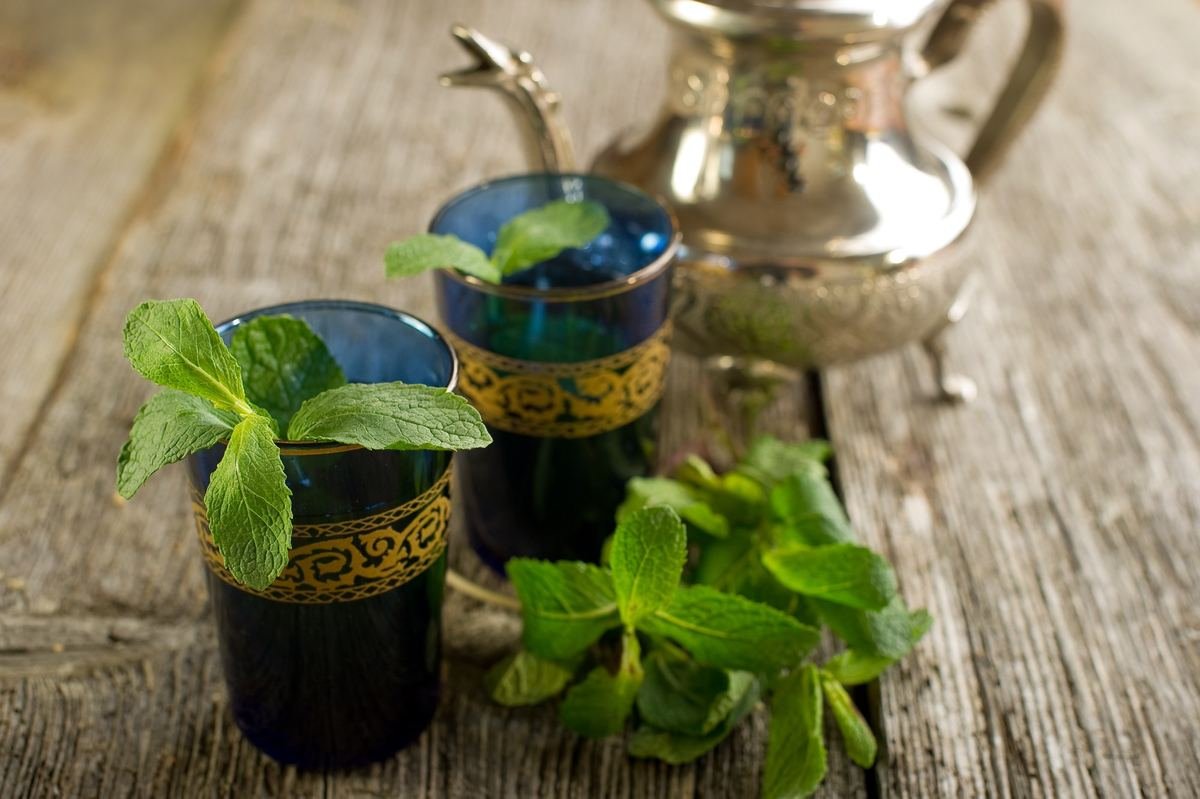
Where to buy. In Marrakech, metalwork is sold in the souks north of Jemaa el-Fna and around Place des Ferblantiers near the Mellah. In Fez, Seffarine square is the centre of brass and copperwork. Glass sets are sold in every medina and, more cheaply, in ordinary household shops and supermarkets in the new towns.
Typical prices (after bargaining):
- Small machine-made teapot: approx. 80–200 MAD
- Heavier, well-finished teapot: approx. 250–700 MAD
- Engraved or hand-finished brass tray: approx. 150–600 MAD depending on size
- Set of six tea glasses: approx. 40–150 MAD; hand-painted or gilded sets cost more
How to judge quality.
- Weight. A good teapot is heavy for its size. Very light pots are thin aluminium and dent easily.
- Joins. Check that the handle, spout and lid are soldered firmly, not glued.
- Lid and spout. The lid should sit snugly on its hinge. Look inside: a strainer behind the spout keeps leaves out.
- Origin. Many cheap pots in the souks are imported. Ask the seller where it was made, look for a maker's stamp on the base, and compare finishes in two or three shops before you buy. Wrap glasses in clothing in your hold luggage; gunpowder tea packs easily, fresh mint does not.
To make it at home, use 1 tablespoon of gunpowder tea, a large handful of spearmint and 3–5 teaspoons of sugar for a 750 ml pot, following the steps above. Many cooking classes start with a tea-making lesson.
Frequently asked questions
Is it rude to refuse mint tea in Morocco?
Refusing every glass can seem unfriendly, especially in a home. Accept one and sip a little. When you have had enough, put your hand on your heart and say "safi, shukran".
Why is Moroccan tea poured from so high?
The height aerates the tea, cools it slightly and creates a foam on top that Moroccans consider the mark of a well-served glass. It also helps mix the sugar.
Can I get Moroccan mint tea without sugar?
Yes, in cafés and restaurants: ask for "bla sukkar" before they make it, or ask for the sugar on the side. In homes the tea is usually sweetened in the pot.
How much is mint tea in Marrakech?
Around 8–15 MAD a glass in a neighbourhood café, 20–40 MAD on a rooftop terrace overlooking Jemaa el-Fna, and more in boutique hotels.
What is the best teapot to buy in Morocco?
Choose a heavy, well-soldered teapot with a snug lid and an internal strainer. Expect to pay roughly 250–700 MAD for a good one; very light, cheap pots are usually thin aluminium.
Related: Harira · Moroccan souks · Merzouga and the desert · Moroccan food guide
This guide was last reviewed in November 2026. Entry rules, opening hours, transport timetables and prices change; check official sources shortly before you travel. Spotted something out of date? Tell us.