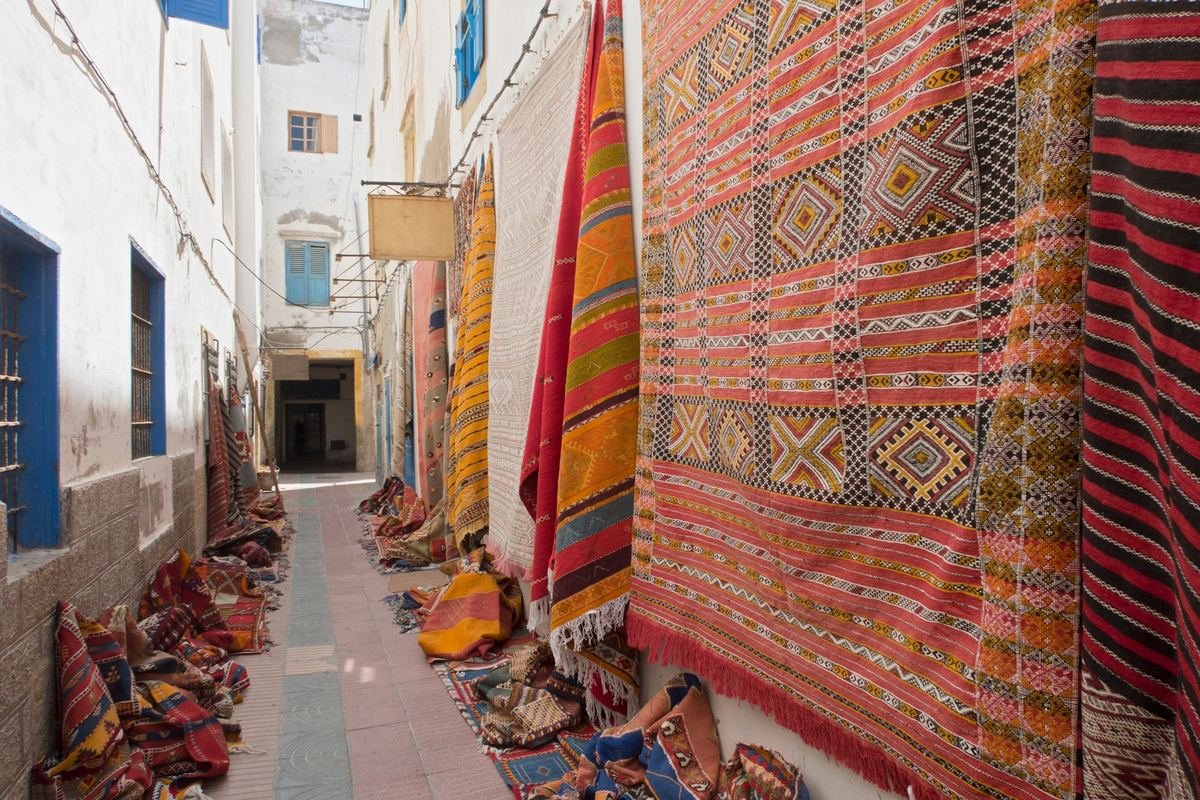
Where crafts are made, not just sold
Most cities specialise, and buying near the source means more choice and fewer middlemen.
| Craft | Where it is made | Quality signs |
|---|---|---|
| Rugs | Middle and High Atlas, Taznakht | Hand-knotted wool, irregular motifs |
| Leather | Fez tanneries, Marrakech (Bab Debbagh) | Even stitching, lined interiors |
| Ceramics | Fez (Ain Nokbi), Safi, Tamegroute | Hand-painted lines, smooth glaze |
| Thuya wood | Essaouira | Burl figure, flush inlay |
| Brass | Fez (Seffarine), Marrakech (Kasbah) | Hand-pierced, heavy |
| Argan oil | Souss, Essaouira–Agadir | Cooperative label, pressing date |
Rugs: types by region
Moroccan rugs fall into two families: knotted pile rugs, mostly from the Atlas, and flatweaves (kilims, called hanbel or akhnif depending on the region).
- Beni Ourain (Middle Atlas): thick, undyed cream wool with dark lozenge lines. The most copied style in the world; genuine pieces feel heavy, oily and slightly uneven.
- Azilal (central High Atlas): white or cream base with bright, free-form symbols, often in red, orange and blue.
- Boucherouite: rag rugs knotted from recycled textiles. Cheerful, inexpensive and honest about what they are.
- Taznakht and the Ouzguita region (between Ouarzazate and Taroudant): dense, deep-red or saffron rugs, often dyed with madder and henna; the town has a large weaving cooperative scene.
- Glaoua (Ouarzazate and Telouet area): a mix of flatweave and pile in one rug.
- Zemmour and Zayane (Khemisset and Khenifra regions): red flatweaves with geometric bands.
- Rabat rugs: urban, finely knotted, with a central medallion; traditionally made in town workshops rather than villages.
How to judge a rug
- Turn it over. The back of a hand-knotted rug mirrors the front, slightly irregular. A perfect grid or a glued latex backing means machine-made.
- Check density. Village rugs are coarse; fine Rabat work is much denser. More knots mean more hours, not automatically a better village rug.
- Check the fringe. A real fringe is the end of the warp threads; a sewn-on fringe signals machine production.
- Rub the dye with a damp white tissue. Slight transfer is common; heavy bleeding means it will run. Subtle bands of shade (abrash) are normal with natural dyes.
- Feel the wool. Hand-spun wool keeps some lanolin; acrylic feels squeaky. In a burn test, wool smells of burnt hair and acrylic melts into a bead.
- Question "vintage". Many "old" rugs are a few years old and sun-faded. Fine, if the price reflects it.
Rug price guide (2026, after negotiation)
| Rug | Typical size | Approx. price |
|---|---|---|
| Boucherouite | 1 × 1.5 m | 500–1,500 MAD |
| Flatweave kilim / hanbel | 1.5 × 2.5 m | 1,500–5,000 MAD |
| Azilal or Taznakht pile | 1.5 × 2.5 m | 3,000–9,000 MAD |
| Beni Ourain, new, hand-knotted | 2 × 3 m | 6,000–18,000 MAD |
| Fine old or collector rug | any | 20,000 MAD and up |
Opening prices in rug shops can be two or three times these figures. A carpet "demonstration" with tea is pleasant and normal; you owe nothing except politeness.
Leather from Fez and Marrakech
Fez is the historic centre of tanning, in the stone vats of the Chouara and smaller Sidi Moussa tanneries; Marrakech's tanneries are around Bab Debbagh. You view the vats from leather-shop terraces, then see the stock.
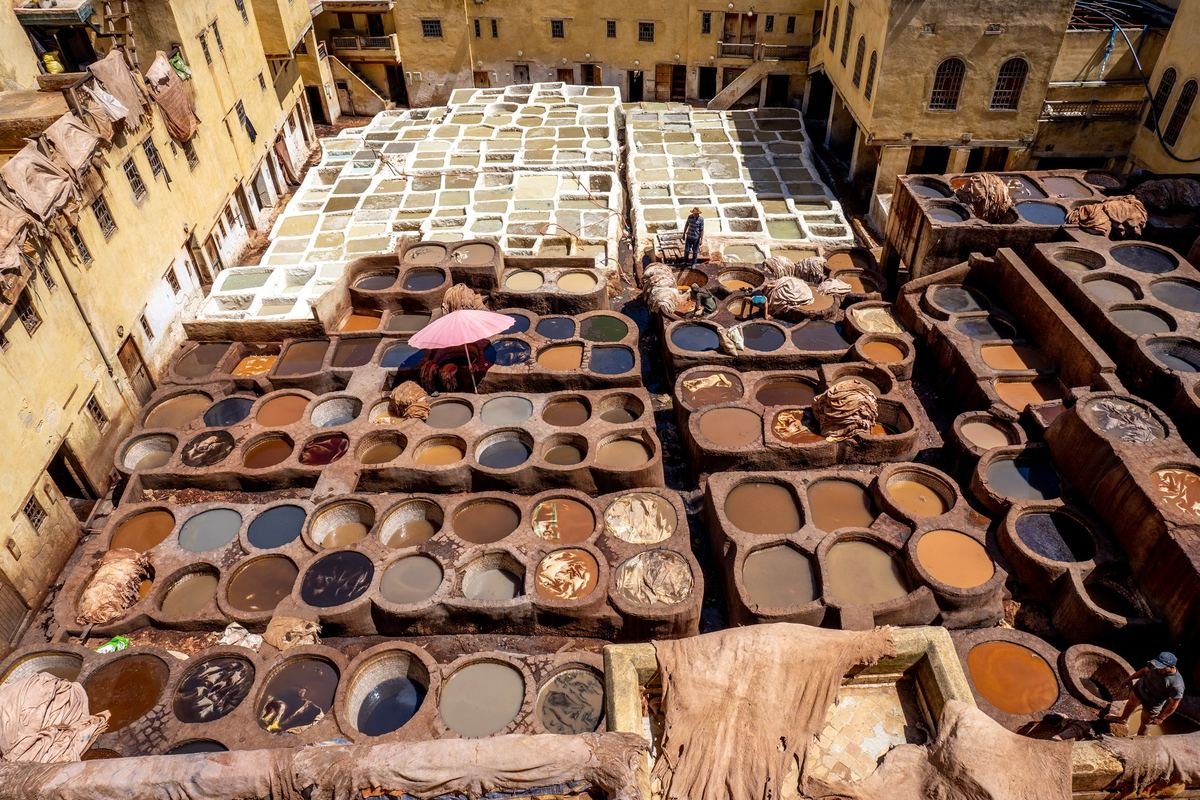
Good leather is supple, smells of leather rather than chemicals, and has dense stitching. Check inside for cardboard stiffeners. "Camel leather" is often goat or cow. Typical prices: babouche slippers approx. 80–250 MAD; an unstuffed pouf approx. 250–600 MAD (stuff it at home with old clothes or foam); a medium handbag approx. 400–1,200 MAD; a leather jacket approx. 1,500–3,500 MAD.
Ceramics: Fez blue, Safi and Tamegroute
- Fez blue (bleu de Fès): cobalt on white, with fine geometric or floral patterns. The potters' workshops are in the Ain Nokbi quarter outside Bab Ftouh, where you can watch zellige tiles being cut too. Plates approx. 150–600 MAD depending on size.
- Safi, on the Atlantic coast, is Morocco's largest pottery town. The Colline des Potiers (Potters' Hill) is lined with kilns and workshops; glazes are bolder, often turquoise, green and black.
- Tamegroute, in the Draa Valley, makes rustic pottery with a distinctive green glaze.
Hand-painting shows brush variation; printed copies are identical. Decorative pieces may use lead glazes: keep them for display. For cooking, buy plain unglazed or food-safe glazed clay tagines (approx. 30–100 MAD), and see our tagine guide.
Thuya wood from Essaouira
Thuya is a fragrant conifer from the hills behind Essaouira. Craftsmen use the swirling root burl for boxes, chess sets and inlaid tables, in workshops inside the ramparts near the Skala de la Ville. Real thuya smells resinous, like cedar, when you scratch the base. Thick varnish or a uniform pattern suggests cheaper wood with a printed veneer. Small boxes approx. 60–250 MAD; inlaid jewellery boxes approx. 300–900 MAD. See our Essaouira guide.
Brass lanterns and metalwork
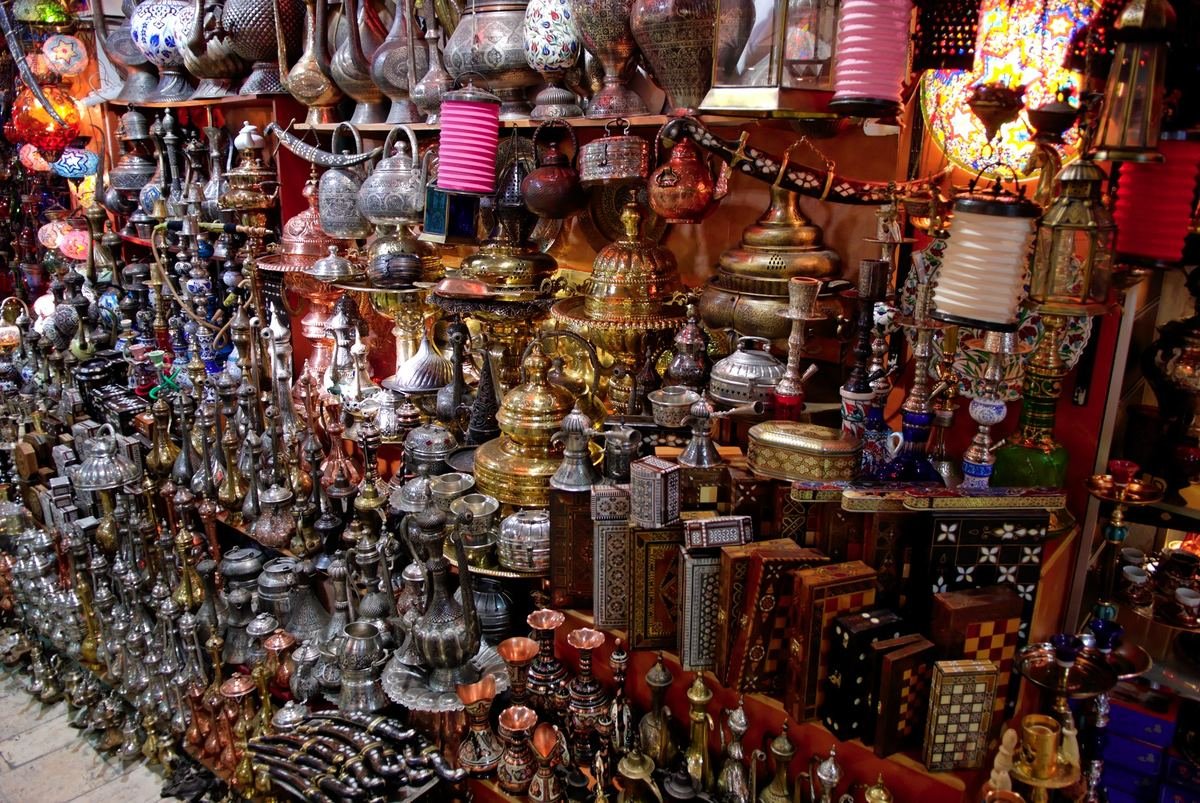
Lanterns are punched by hand from sheet metal. In Fez, listen for the hammers on Seffarine square; in Marrakech, workshops cluster around Place des Ferblantiers near the Kasbah. Hand-piercing shows tiny irregularities; stamped pieces are uniform and light. Many "brass" lanterns are plated iron: a magnet sticks to iron, not brass. Small lanterns approx. 150–400 MAD; large hanging ones approx. 800–3,000 MAD. Plan to rewire for your country.
Argan oil and cooperatives
The argan tree grows only in south-west Morocco, and the knowledge around it was inscribed by UNESCO as intangible heritage in 2014. Women's cooperatives in the Souss region, along the Essaouira–Agadir road, crack the nuts by hand and press the oil.
- Cosmetic argan is cold-pressed from raw kernels and nearly odourless; culinary argan comes from roasted kernels and smells nutty.
- Expect approx. 100–250 MAD for 100 ml of pure cosmetic oil in 2026. Much cheaper bottles in the souks are often blended with other oils.
- Look for a sealed bottle, a pressing date and the cooperative's name and certification on the label.
- Road-side "cooperatives" on tour routes are sometimes shops in costume. A real one lets you see the work and does not push.
Fakes and misleading labels
- "Cactus silk" (sabra): sold as agave fibre, but most of it in the souks is viscose (rayon) from wood pulp. Pretty and dyeable, but not silk, and not priced like silk.
- "Silk" scarves and carpets: real silk is rare. Burnt silk smells of hair and crumbles; synthetics melt.
- "Antiques": most are new. Genuine antiques need export paperwork.
- "Amber" and "silver": much is resin and nickel alloy.
Bargaining, fixed prices and the Ensemble Artisanal
Bargaining is expected in the souks; see our method on the souks page. For a benchmark, first visit a state-run Ensemble Artisanal (in Marrakech, on Avenue Mohammed V near the Koutoubia), where artisans sell at fixed prices without pressure. Those prices are a fair ceiling for the same quality in the medina.
Guides and drivers often take a 20–40% commission in shops they bring you to. Say at the start whether you want shops at all.
Shipping and taking crafts home
- Carry it: a 2 × 3 m wool rug folds into a bag of about 10–15 kg; shops will tie it for you. Check your airline's baggage limits.
- Shop shipping: established dealers ship by courier. Get a written receipt with item, size, price and shipping cost, and photograph the rug before it leaves.
- Customs: duty rules changed in several countries in 2025–2026. The UK personal allowance is £390; check your own customs authority before a big purchase.
- VAT refund: participating shops issue tourist VAT refund forms for large purchases; present the goods at the airport before check-in.
See also money and payments for cash, cards and ATMs.
Frequently asked questions
How much should I pay for a Beni Ourain rug in Morocco?
For a new, hand-knotted Beni Ourain of about 2 × 3 metres, roughly 6,000–18,000 MAD in 2026, depending on wool quality and knot density. Opening prices are often far higher.
Is cactus silk real silk?
No. Most "cactus silk" sold in Morocco is viscose, a regenerated cellulose fibre. It is attractive and washable on a cool cycle, but it should cost far less than silk.
Where is the best place to buy leather in Fez?
Around the Chouara tannery and the lanes leading to it from Talaa Kebira. Compare at least three shops and check stitching and lining before negotiating.
Can I ship a rug home from Morocco?
Yes. Most rug dealers ship by courier and include insurance. Ask for a written invoice and tracking, and check your country's import duty rules.
Are painted Moroccan tagines safe to cook in?
Many decorative tagines use lead glazes and are for serving or display only. For cooking, choose plain terracotta or a glaze the seller confirms is food-safe.
Related: Moroccan souks · Fez guide · Mosaic workshop · Amazigh culture
This guide was last reviewed in November 2026. Entry rules, opening hours, transport timetables and prices change; check official sources shortly before you travel. Spotted something out of date? Tell us.